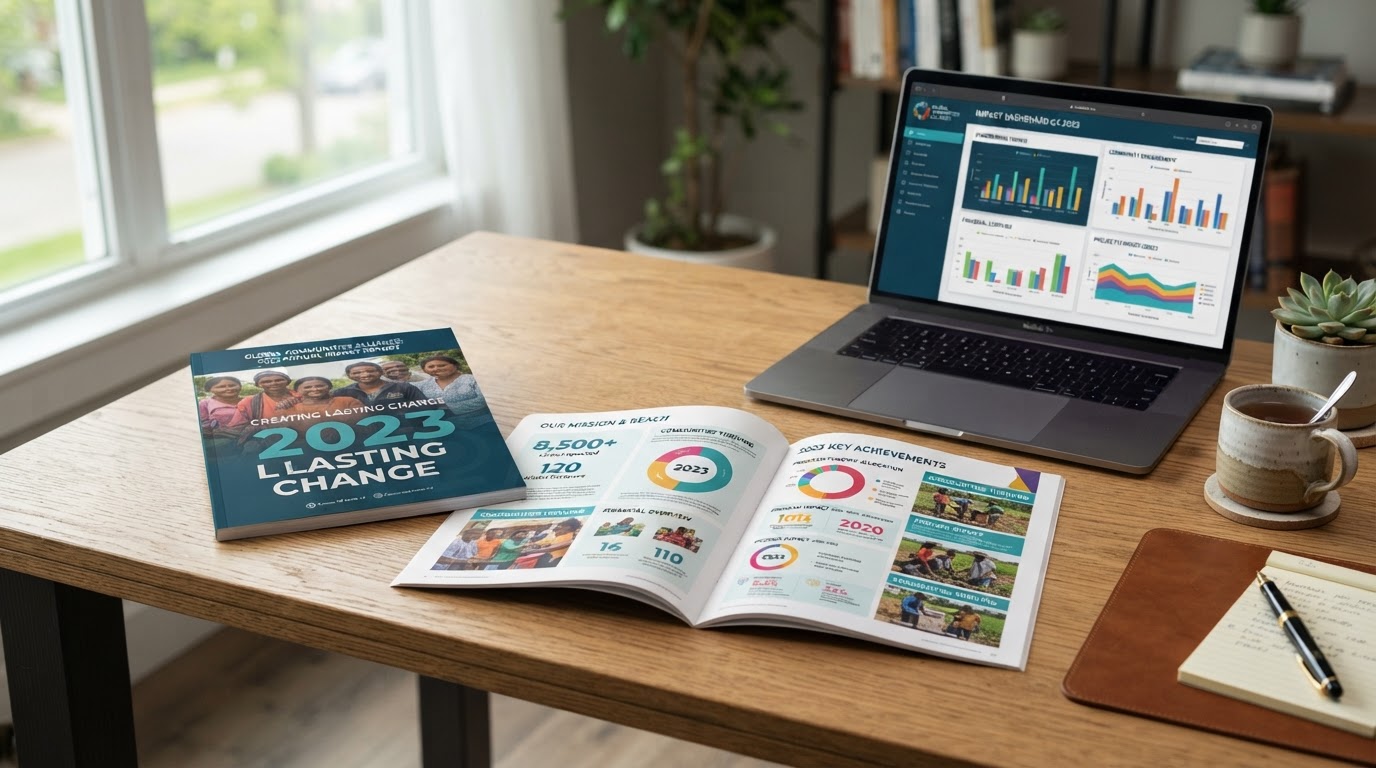
Damon Boswell opens every storytelling engagement at ASAP Grants with an exercise that exposes the gap between organizations donors remember and organizations donors forget. He asks the team to name three nonprofit brands they personally support and explain why. The answers are never about efficiency ratios, overhead percentages, or program metrics — they are about stories. A specific person helped. A moment that moved them. A narrative that made them feel like the hero of someone else's transformation. Damon's framing is unsentimental: donors do not give to organizations. Donors give to stories, and the organization that tells a story the donor can step into is the organization the donor funds, while the organization that presents a case statement is the organization the donor respects and forgets.
In this article, Damon and Ashley Boswell walk through the storytelling engine we build for ASAP Grants clients — the brand voice framework, the donor-as-protagonist narrative architecture, the story library that feeds every channel, the channel-calibrated copy that maintains consistency without monotony, and the measurement that turns storytelling from an art into a managed system. This sits inside our Copywriting & Editing and Branding & Website services, and it is the discipline that separates a donor base that feels connected from one that simply transacts.
Why 2026 Made Storytelling the Fundraising Strategy
The case for storytelling as a core fundraising strategy is no longer aspirational; it is behavioral data. OneCause's 2026 research, surveying 1,273 fundraising professionals, found that donor engagement, donor fatigue, and recurring giving rose to the top as the biggest challenges shaping 2026 fundraising — and every one of those challenges is a storytelling problem in disguise. Donor fatigue is the exhaustion of receiving communication that does not move the donor, and communication that does not move the donor is communication that tells no story. The DonorPerfect 2026 acquisition research adds the conversion data: 57% of new donors actively seek information about the cause itself, 72% actively seek information about the nonprofit specifically, and 75% of regular donors seek information about the nonprofit's impact. The donors are looking for the story — the question is whether the organization is telling one or presenting a brochure. Damon's point is that the donor who searches for your cause and finds a case statement has found an organization; the donor who searches for your cause and finds a story has found a home.
Ashley frames the shift for every team we work with: storytelling is not a layer you add to the fundraising strategy. It is the fundraising strategy, because every fundraising activity — the appeal letter, the grant narrative, the social media post, the impact report, the event speech — is a story or it is nothing. The GiveBackNation 2026 nonprofit strategy research reinforces the convergence: branding, storytelling, and engagement are no longer separate disciplines but integrated practices, and the organizations that treat them as one build a voice that compounds across every touchpoint while the organizations that treat them as separate produce a brand that feels different in every channel and coherent in none of them. Damon's rule is that a brand voice is not a style guide — it is a narrative promise, and the promise that is consistent is the promise the donor trusts.
The ASAP Grants Storytelling Architecture
Damon builds every storytelling program around a five-layer architecture that moves an organization from ad-hoc communication to a voice that compounds across every channel. Each layer has a purpose, because storytelling without structure is storytelling that drifts into inconsistency the moment the team changes.
1. The Brand Voice Framework
The first layer is the foundation, and Ashley treats it as the constitution every piece of communication must satisfy. A brand voice framework is not a tone-of-voice adjective on a slide — it is a defined set of linguistic choices that make the organization's voice recognizable across every channel and every writer. The framework defines the vocabulary the organization uses and the vocabulary it does not, the sentence structures that carry the brand's cadence, the emotional register the voice operates in, and the relationship the voice assumes with the reader. The GiveBackNation 2026 guidance treats branding and storytelling as integrated practices precisely because a brand without a voice is a logo, and a voice without a framework is a mood. Damon's rule is that the brand voice framework is the single document that makes ten different writers sound like one organization, and the organization that does not define its voice has no voice — it has whatever the last person to write the email felt like saying.
2. The Donor-as-Protagonist Narrative
Once the voice is defined, Damon builds the narrative architecture that positions the donor as the protagonist of the story rather than the audience of the organization's achievements. This is the shift that separates storytelling from reporting, and it is the discipline most nonprofits never make. The default nonprofit narrative is: we saw a problem, we built a program, we served people, please fund us. The donor-as-protagonist narrative is: you saw a problem that no one else was solving, you decided to be the person who changed it, here is the life that changed because you did. The first narrative makes the organization the hero; the second makes the donor the hero, and the donor who is the hero of the story is the donor who stays in the story. Ashley's rule is that the donor does not fund the organization's work — the donor funds their own values in action, and the story that shows the donor their values in action is the story the donor funds.
3. The Story Library
This is the layer where most storytelling programs quietly starve, and Damon treats it as the operational engine that makes storytelling sustainable. A story library is a curated, organized, continuously updated repository of stories — the specific person, the specific moment, the specific outcome — that every channel can draw from. An appeal letter needs a story; a grant narrative needs a story; a social media post needs a story; an impact report needs a story; an event speech needs a story. An organization without a story library treats every communication as a new creative project, and the creative cost of producing stories from scratch for every touchpoint is the cost that eventually makes the team stop telling them. The DonorPerfect 2026 guidance is that storytelling is what keeps donors close — but only if the storytelling is sustained, and sustained storytelling requires a library that is built once and drawn from continuously. Ashley's rule is that the story library is the asset that makes storytelling a system rather than an event, and the organization that builds the library tells stories forever while the organization that does not tells stories until the team gets tired.
4. The Channel-Calibrated Copy
The fourth layer is the one that turns a brand voice into channel-specific communication without losing consistency, and Ashley treats it as the discipline that prevents the brand voice from becoming monotone. The voice is consistent; the copy is calibrated. An appeal letter and a social media post and an impact report share the same voice — the same vocabulary, the same emotional register, the same donor-as-protagonist architecture — but they differ in length, in structure, in immediacy, and in the specific story they draw from the library. The GiveBackNation 2026 guidance on branding and storytelling as integrated practices is precisely about this calibration: the brand is one, but the channels are many, and the voice that is identical across channels is a voice that feels automated, while the voice that is consistent but calibrated is a voice that feels present. Damon's rule is that consistency is not repetition — it is coherence, and the copy that is calibrated to the channel while consistent in voice is the copy that the donor recognizes whether they are reading an email, scrolling a feed, or opening a report.
5. The Storytelling Measurement
The final layer is the one that turns storytelling from an art into a managed system, and Damon insists on it for every engagement. We measure four indicators: the story inventory — how many stories are in the library and how current they are; the story utilization — how many communications drew from the library versus being written from scratch; the engagement differential — the open rates, click rates, and response rates of story-led communications versus non-story communications; and the donor feedback — the qualitative signals that tell us which stories resonated and which fell flat. The engagement differential is the metric that justifies the entire investment, because a story-led appeal that outperforms a non-story appeal by 40% on response rate is not a soft benefit — it is revenue. Ashley's rule is that storytelling that is not measured is storytelling that cannot be improved, and the organization that does not measure the difference between its story-led and non-story communications is the organization that cannot prove the story is worth the telling.
Donors do not give to organizations. Donors give to stories they can step into. The brand voice is the door. — Damon Boswell
The Donor Fatigue Diagnosis
Ashley reframes donor fatigue for every team we work with, because the diagnosis most teams reach is wrong. Donor fatigue is not the exhaustion of donors who have been asked too often — it is the exhaustion of donors who have been communicated to without a story too often. The OneCause 2026 research named donor fatigue among the top challenges shaping fundraising, and the GiveBackNation 2026 strategy guidance frames the solution as integrated branding and storytelling — not fewer communications, but more story-led communications. A donor who receives ten story-led appeals a year is not fatigued; they are engaged. A donor who receives ten case-statement appeals a year is fatigued, and the fatigue is not the frequency — it is the absence of the story that would have made the frequency feel like a relationship rather than a transaction. Damon's rule is that donor fatigue is a storytelling failure, not a frequency failure, and the organization that solves the storytelling solves the fatigue without reducing the communication that sustains the relationship.
The Three Storytelling Failures
Damon closes every storytelling engagement by naming the three failures that turn a narrative asset into a forgettable brochure.
- The organization-as-hero failure: every story the organization tells is about what the organization did, what the organization achieved, and what the organization needs — and the donor is never the protagonist. The donor who reads ten stories about the organization's accomplishments is the donor who concludes their gift was unnecessary, because the organization appears to have already succeeded. The donor must be the person who made the success possible, because the story that does not need the donor is the story the donor does not fund.
- The ad-hoc failure: every communication is a new creative project with no story library, no brand voice framework, and no channel calibration, so the storytelling is unsustainable and eventually abandoned when the creative cost exceeds the team's capacity. Storytelling that is not built into a system is storytelling that happens when someone has the energy and stops when they do not, and the organization that relies on energy instead of architecture is the organization whose voice disappears the moment the team turns over.
- The unmeasured failure: the organization tells stories and never measures whether the stories moved the donor, so it cannot distinguish the story that converted from the story that was ignored, and it repeats the failures while discarding the successes. The storytelling that is not measured is the storytelling that cannot improve, and the organization that tells the same story for ten years without knowing whether it works is the organization whose storytelling is a ritual rather than a strategy.
Build the Voice Before You Need the Donor
The most common storytelling failure Ashley sees is not a lack of stories — the organizations are full of stories. The failure is the absence of a system that defines the voice, positions the donor as the protagonist, stores the stories in a library, calibrates the copy to the channel, and measures the difference the story makes. An organization with 500 beneficiaries and no story library is an organization that tells stories manually until the team burns out. The same organization with a brand voice framework, a story library of 40 curated narratives, and a measurement dashboard that proves the story-led appeal outperforms the non-story appeal by 40% is an organization that tells stories forever, because the system makes it cheaper to tell the story than to skip it. Damon's rule is that the storytelling engine is built before the donor base erodes, not after the appeal response drops, because the day the response drops is the day the donor already stopped believing the story.
This is also why Damon treats storytelling as a governance discipline, not just a communications function. The board that understands that 57% of new donors seek information about the cause, that donor fatigue is a storytelling failure, and that the story-led appeal outperforms the case-statement appeal plans differently — it invests in the voice before the campaign, it builds the library before the appeal, and it treats the story as the asset the donor is actually buying. An organization that builds that understanding into its leadership builds a donor base that believes, and an organization that does not is one appeal away from discovering that the donors it thought it had were transacting with a brochure that never told them why they mattered.
Tell the Story the Donor Steps Into
If your communications are case statements instead of stories, your donor is the audience instead of the protagonist, and your storytelling happens when someone has the energy rather than when the system demands it, the problem is not your mission. The problem is the absence of a storytelling engine that defines the voice, builds the library, calibrates the copy, and measures the difference. Damon and Ashley Boswell build complete storytelling programs — brand voice framework, donor-as-protagonist narrative, story library, channel-calibrated copy, and storytelling measurement — as part of ASAP Grants' Copywriting & Editing and Branding & Website services. Schedule a free consultation, and let us build the voice that turns donors into believers.
Damon & Ashley Boswell
Founding Partners, ASAP Grants
Ashley & Damon Boswell are the founding partners of ASAP Grants, a nationwide professional firm specializing in 501(c)(3) formation, grant writing, and holistic fundraising for nonprofits. Since 2010, they have maintained a 100% success rate on nonprofit filings and helped organizations across all fifty states secure sustainable funding.