Ashley and Damon Boswell start every copywriting engagement at ASAP Grants with a truth that most nonprofits resist: your mission is not the reason people give. People give because a story made them feel that their money would change something they care about. The mission is the foundation that makes the gift credible, but the story is the instrument that makes the gift happen. Damon puts it directly: you can have the most important mission in your city and raise nothing, because importance does not move people — narrative does. The words are the work.
In this article, Damon and Ashley walk through the copywriting and editing discipline we practice at ASAP Grants — the narrative architecture, the generational calibration, the channel-layered campaigns, and the editorial standard that turns nonprofit writing from mission description into donor conversion.
Why 2026 Made Professional Copywriting a Funding Decision
The case for professional copywriting is no longer soft. DonorPerfect's 2026 impact-story research establishes that well-constructed narratives drive engagement across every channel — email campaigns, social posts, annual reports, peer-to-peer pages, and donation forms — because a single unified story, told consistently, compounds across touchpoints. CCS Fundraising's generational communications research adds the harder finding: one nonprofit communications strategy no longer fits all donors. Millennials, now the most responsive generation overall, score highest across nearly every channel, including email and direct mail, and over half prefer to give online in response to a mailed appeal. The implication is that the same organization now must write for multiple audiences, in multiple registers, across multiple channels — and the copy that works for a Boomer direct-mail letter fails on a Millennial's phone screen.
Ashley's reading of this research is unforgiving toward the sector's default. Most nonprofits still write one appeal, send it everywhere, and wonder why response rates fall every year. In 2026, that is not a strategy — it is a slow bleed. The organizations that win are the ones that write to the donor in front of them, in the register that donor reads in, on the channel that donor responds to. That is professional copywriting: not fancier words, but the right words for the right reader at the right moment.
The First Principle: Donors Fund Stories, Not Statistics
Damon opens every copywriting engagement by separating two things that nonprofits constantly confuse: the case for support and the story for giving. The case for support is the logical argument — the need, the solution, the evidence, the budget. It belongs in the grant proposal. The story for giving is the emotional vehicle — a single person, a single moment, a single transformation that makes the case feel real. It belongs in the appeal letter. Conflating them produces writing that is too cold for donors and too anecdotal for funders, and satisfies neither.
DonorPerfect's guidance on impact stories confirms the architecture: the effective narrative arc builds from identifying the protagonist to illustrating the outcome, and then invites the donor to play a role with language that connects donor engagement directly to specific outcomes. Ashley adds the discipline that most organizations miss: the donor must be the hero of the story, not the organization. When the organization casts itself as the hero, the donor's role shrinks to a transaction. When the donor is the hero, the gift becomes the decisive act — and that is the framing that produces repeat giving.
The ASAP Grants Copywriting Architecture
Ashley builds every copywriting system around a four-part architecture that moves from audience definition to published copy, with editing as a distinct and protected stage — because writing without editing is a draft, and drafts do not raise money.
1. Audience and Motivation Mapping
Before a word is written, Damon maps the audience. Who is this piece for — a lapsed major donor, a first-time online giver, a foundation program officer, a corporate sponsor? Each audience has a different motivation, a different reading context, and a different ask. The CCS generational research makes this non-negotiable: Millennials respond to online, integrated, QR-enabled campaigns; Boomers respond to direct mail followed by digital reinforcement. Writing without an audience map is writing for everyone, which means writing for no one. Ashley requires an audience definition and a primary motivation statement before any drafting begins.
2. The Narrative Arc
Ashley structures every appeal around a clear narrative arc, following the impact-story framework that research shows converts. The arc opens with a specific person and a specific moment — not a statistic, not a mission statement, a person. It establishes the stakes. It introduces the intervention the donor can enable. It illustrates the outcome. And it invites the donor to play a role with a clear, specific next step. The discipline is that every appeal is a complete story with a beginning, a turning point, and an ask — not a brochure of activities with a donate button stapled to the end.
Damon is blunt about the most common arc failure: the appeal that never asks. Organizations afraid to ask write three pages of warm sentiment and end with 'consider supporting us.' That is not an ask. That is a suggestion. An ask is specific, concrete, and tied to an outcome the donor can picture: a gift of $250 provides one month of mentorship for a young person in our program. Specificity is what separates a fundraising letter from a newsletter.
3. Channel-Layered Campaigns
The CCS finding that 53% of Millennials prefer to give online in response to a mailed appeal is not a trivia fact — it is a campaign architecture. Ashley builds layered, integrated campaigns in which each channel reinforces the others: a direct mail piece carries a QR code or personalized short URL, an email reminder follows, a text prompt nudges, and the donation form reflects the same story the donor already read. The principle is that a donor encounters the story multiple times across channels before being asked to act, and that repetition — not a single heroic email — is what produces conversion.
Damon adapts the copy to each channel rather than pasting the same text everywhere, because reading behavior differs by medium. A direct mail letter can run two pages and lean into long-form storytelling. An email must earn the open with a subject line, deliver value in the first three lines, and respect the scan. A social post has seconds. The same story, three registers, one campaign — and the donor who sees the mail piece, the email, and the post experiences one coherent narrative rather than three disconnected asks.
4. The Editing Standard
This is the stage most nonprofits skip, and Ashley considers it the most important. Editing is not proofreading. Editing is the discipline of cutting everything that does not serve the donor, sharpening every sentence, and ensuring the ask is unmistakable. The first draft is almost always too long, too organization-centered, and too soft on the ask. The edited version is shorter, donor-centered, and explicit. Damon's rule is that a good appeal loses at least a third of its words between first draft and final — and the version that lost the words is the one that raises the money.
The first draft is where you figure out what you want to say. The edit is where you figure out what the donor needs to hear. Those are different sentences, and the difference is the difference between an appeal that raises and one that is filed. — Ashley Boswell
Where Copywriting Lives Across the Organization
Damon is clear that copywriting is not a single deliverable — it is a discipline that runs through every donor-facing word the organization publishes. The annual appeal is the obvious one, but the same standard applies to the website's donate page, the grant proposal's narrative, the impact report's opening, the stewardship letter after a major gift, and the corporate sponsorship pitch. Ashley audits all of it, because a donor who reads a beautiful appeal letter and then lands on a confusing donate page experiences a break in trust — and trust breaks are where gifts die.
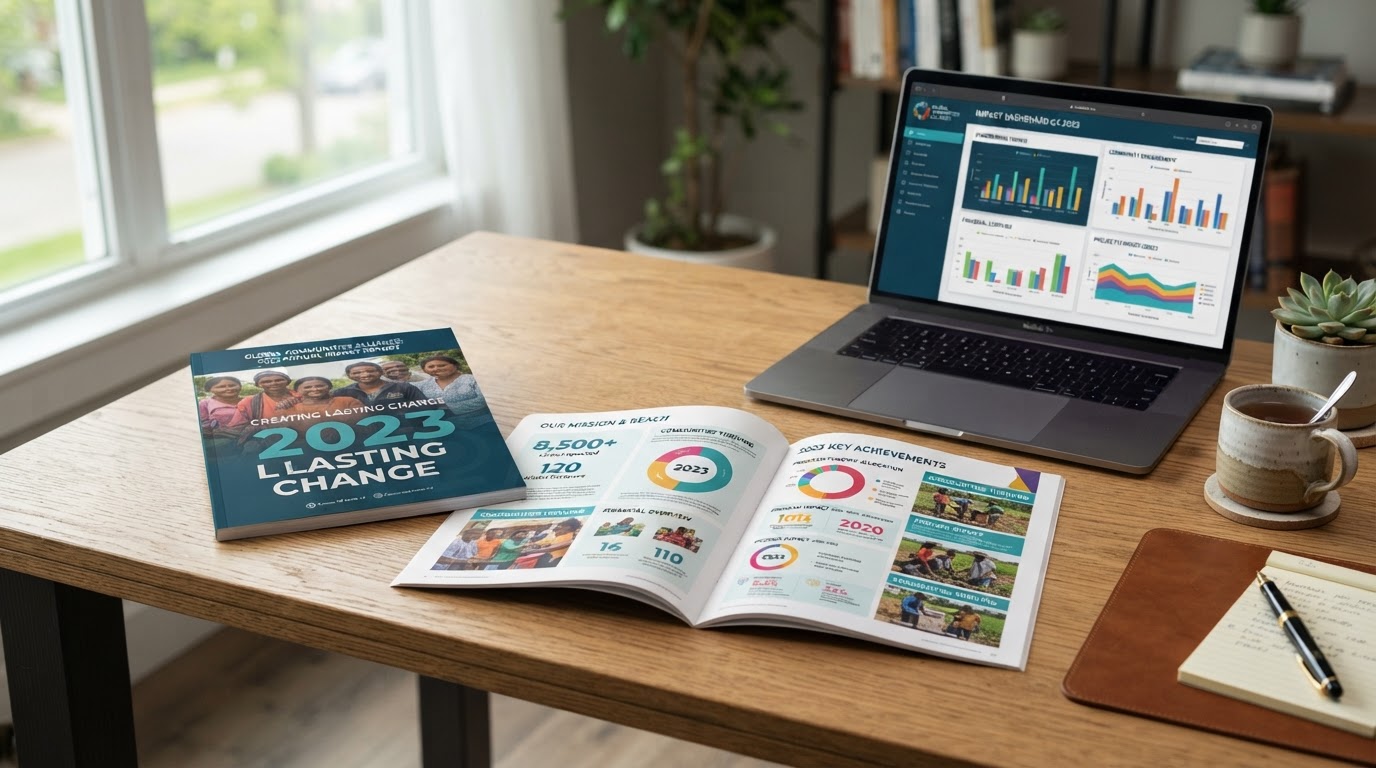
This is where copywriting intersects with our Branding & Digital Presence work and our Impact Reports service. The brand voice must be consistent from the homepage to the grant report, because a funder who reads a polished proposal and then finds a clumsy, typo-ridden annual report wonders which version is real. Consistency of voice is consistency of trust, and consistency of trust is what makes a funder renew.
The Generational Calibration That 2026 Demands
Ashley returns to the CCS generational data because it reframes how organizations should think about a single donor file. The same organization may have Boomer major donors who respond to a formal, mailed case statement and Millennial mid-level givers who respond to a short, image-led email with a one-tap donation flow. The copy for each must be different — not just in length but in register, in the role of imagery, in the placement of the ask, and in the social proof that bolsters credibility. Millennials, the data shows, are the most responsive generation overall and the most likely to use smartphones and QR codes to donate; designing the Millennial appeal as a shorter version of the Boomer letter wastes the channel.
Damon builds a donor-segmented copy library so that the organization has the right piece for the right reader on demand, rather than writing every appeal from scratch under deadline pressure. The library holds proven subject lines, opening hooks, ask structures, and stewardship templates — all edited to the same standard — so that the writing gets faster and more consistent over time rather than starting from zero each cycle.
Honest Stewardship Copy Builds the Second Gift
The writing that happens after the gift is as important as the writing that produces it, and Ashley treats stewardship copy as a first-class deliverable. The thank-you letter, the impact update, and the next-year appeal are a single relationship told in chapters — and the donor who receives a generic, templated thank-you learns that their gift was a transaction. The donor who receives a specific, named, outcome-tied thank-you learns that their gift mattered. That difference is the difference between a one-time giver and a recurring supporter.
DonorPerfect's research on storytelling and stewardship makes the connection explicit: consistent storytelling keeps donors informed, engaged, and confident by showing the real difference their generosity makes, and the most effective stewardship aligns impact stories with donor motivation and giving behavior. Damon writes stewardship copy that names the donor, references the specific gift, and ties it to a specific outcome — because specificity is what makes a donor feel seen, and donors who feel seen give again.
Write the Words That Move the Mission
If your appeals are written the night before they mail, your grant narratives read like annual reports, and your thank-you letters are templates, the problem is not your mission. The problem is the absence of a copywriting and editing system that treats every donor-facing word as a fundraising decision. Ashley and Damon Boswell build complete copywriting systems as part of ASAP Grants' Impact & Recognition services. Schedule a free consultation, and let us write the words that turn your mission into the gifts that fund it.
Ashley & Damon Boswell
Founding Partners, ASAP Grants
Ashley & Damon Boswell are the founding partners of ASAP Grants, a nationwide professional firm specializing in 501(c)(3) formation, grant writing, and holistic fundraising for nonprofits. Since 2010, they have maintained a 100% success rate on nonprofit filings and helped organizations across all fifty states secure sustainable funding.