Ashley and Damon Boswell begin every custom laser engraving conversation at ASAP Grants with a question that reframes what most nonprofits think recognition is for. They ask: of the last five gifts your organization received, how many donors can name a tangible, physical object that proves their gift was seen? Almost no organization can answer. Most stewardship is invisible — a thank-you email, a ledger entry, a tax receipt. Damon's point is unsentimental: appreciation that the donor cannot see, touch, or point to is appreciation that fades. And faded appreciation is the precursor to a lapsed donor.
In this article, Damon and Ashley walk through why custom laser engraving has become a core part of ASAP Grants' Impact & Recognition services — for donor recognition, for fundraising staff appreciation, and for volunteer appreciation — and how a physical, permanent mark of gratitude changes the economics of retention.
Why Tangible Recognition Matters in 2026
The case for tangible recognition is rooted in donor psychology, and the 2026 donor-wall research makes it explicit. Recognition displays provide tangible acknowledgment that meets a fundamental donor need for appreciation and validation — and that need is not vanity, it is the psychological basis of repeat giving. Digital Record Board's 2026 donor-wall guide and the TouchWall stewardship research converge on the same finding: donors who can point to a physical record of their contribution give again at significantly higher rates than donors whose recognition was entirely digital or verbal. The tangibility makes the relationship real.
Ashley connects this directly to the retention math that drives every ASAP Grants engagement. A lapsed donor is far more expensive to reacquire than an existing donor is to retain, and the cheapest retention lever an organization has is making the existing donor feel genuinely seen. A laser-engraved plaque on a donor wall, a personalized engraved gift at a giving level, or a named brick in a campaign is not a line-item expense. It is a retention investment with a measurable return in renewal rate.
Three Audiences, One Principle: Make the Mark Permanent
Damon organizes our custom laser engraving work around three distinct audiences — donors, fundraising staff, and volunteers — because each audience is retained by a different form of recognition, but all three share the same underlying principle: the mark must be permanent and it must be personal. A generic, mass-produced token communicates the opposite of appreciation. A precisely engraved, named, specific object communicates that someone was seen as an individual.
Donor Recognition
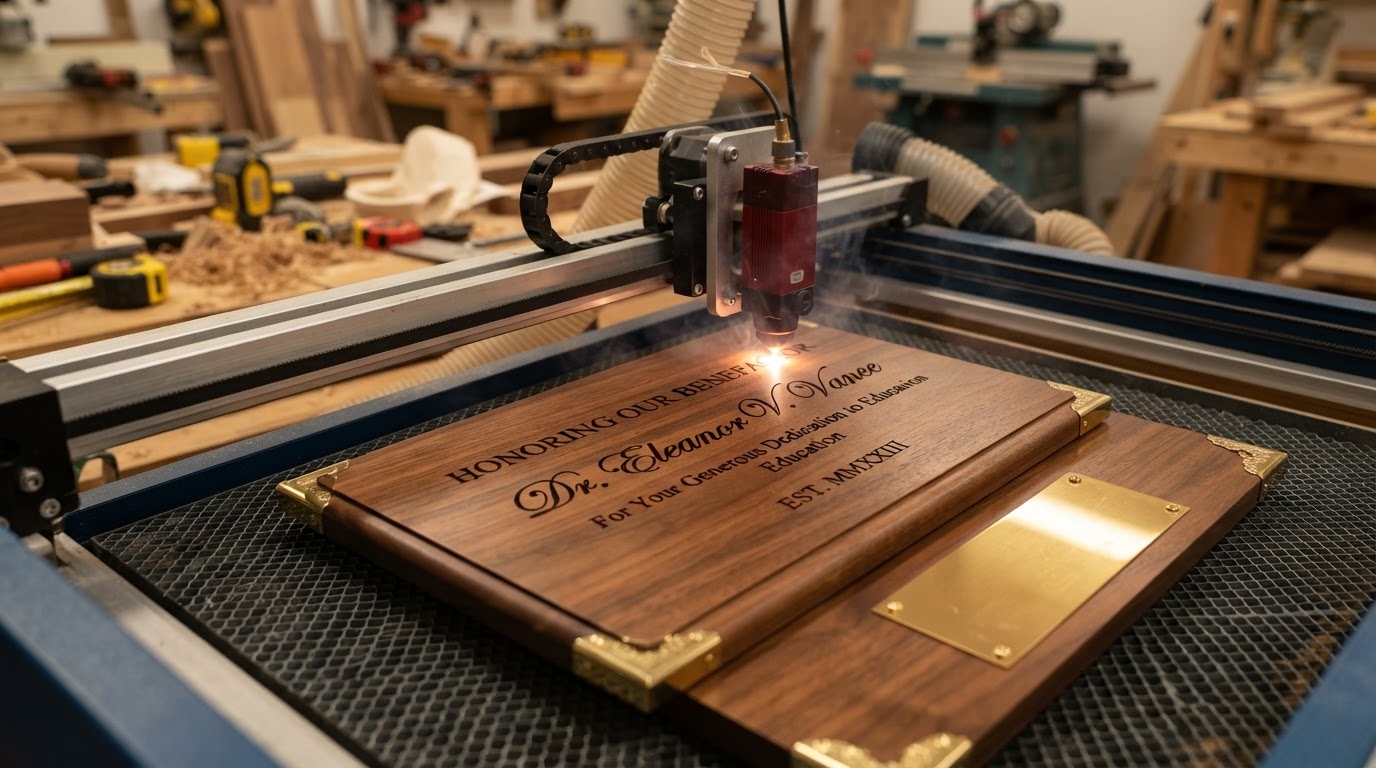
For donors, Ashley designs engraved recognition that scales with giving level and lives in the donor's world. At the entry level, that may be an engraved donor wall plate or a named brick in a capital campaign — the 2026 donor-wall research places engraved brick recognition in a modest per-unit range that makes it practical for broad participation. At the major-gift level, it becomes a personalized engraved piece — a crystal, a wooden presentation plaque, a named feature in a building — that the donor displays in their own home or office. The principle is the same: the recognition travels with the donor or anchors them to the organization's physical space, so that every time they encounter it, the relationship is reinforced.
Damon is specific about why engraved donor walls outperform digital-only recognition for certain donors, particularly older and major-gift constituencies. A digital display is impressive and modern, but it can be updated, reordered, or turned off. An engraved wall is a commitment — it tells the donor that the organization chose a permanent medium to honor a permanent relationship. That perceived permanence is itself a stewardship signal, and major donors read it accurately.
Fundraising Staff Appreciation
This is the audience most organizations forget, and Ashley treats it as urgent given the sector's retention crisis. Fundraising staff turnover averages roughly eighteen months, and as we have written in our development staff coaching work, a meaningful share of voluntary turnover traces to a lack of feeling valued and developed. An engraved recognition — a personalized award at a milestone, a named piece for a campaign completed, a permanent mark on a staff recognition display — is a small, tangible signal that the human behind the fundraising was seen. It will not alone fix a toxic culture, but its absence in a culture that is already fragile accelerates departure.
Damon builds staff appreciation engraving around milestones that mean something: a first successful capital campaign, a sustained giving-level breakthrough, a record grant year. The engraving marks the achievement specifically, not generically, because a plaque that says 'Staff Appreciation' communicates nothing, while a plaque that says 'For leading the 2026 campaign that raised $1.2M and engaged 340 new donors' communicates that the work was measured and mattered. Specificity is what makes recognition feel earned rather than routine.
Volunteer Appreciation
Volunteers are the third retention audience, and Ashley treats them with the same seriousness as donors because the economics are parallel. A trained, reliable volunteer is an investment of hours that would cost real money to replace, and volunteers who do not feel appreciated stop returning. An engraved recognition for a service milestone — a hundred hours, a year of service, a program launched — gives the volunteer a tangible record they can show their family, keep on a desk, or point to when someone asks what they do. That tangible record is how a volunteer's invisible labor becomes visible, and visible labor is retained labor.
The ASAP Grants Engraving Approach
Damon builds our custom laser engraving offering around four design principles that distinguish professional recognition from a plaque shop order.
- Material integrity: we engrave on materials that age well — solid hardwoods, crystal, glass, and architectural metals — so the recognition looks as good in ten years as on the day it was presented. Cheap acrylic clouds; engraved hardwood deepens.
- Personal specificity: every piece names the honoree, the specific contribution, and the date. Generic engravings read as transactions; specific engravings read as relationships.
- Design coherence: the engraving's typography, layout, and finish match the organization's brand, so recognition feels like part of the institution rather than a third-party product. A donor who receives an engraved piece that matches the gala's design language experiences one organization, not two.
- Scalable systems: we build recognition tiers that scale from broad participation (engraved bricks or wall plates at accessible per-unit costs) to bespoke major-gift pieces, so the same program serves the whole donor file rather than only the top.
Recognition as Part of the Stewardship System
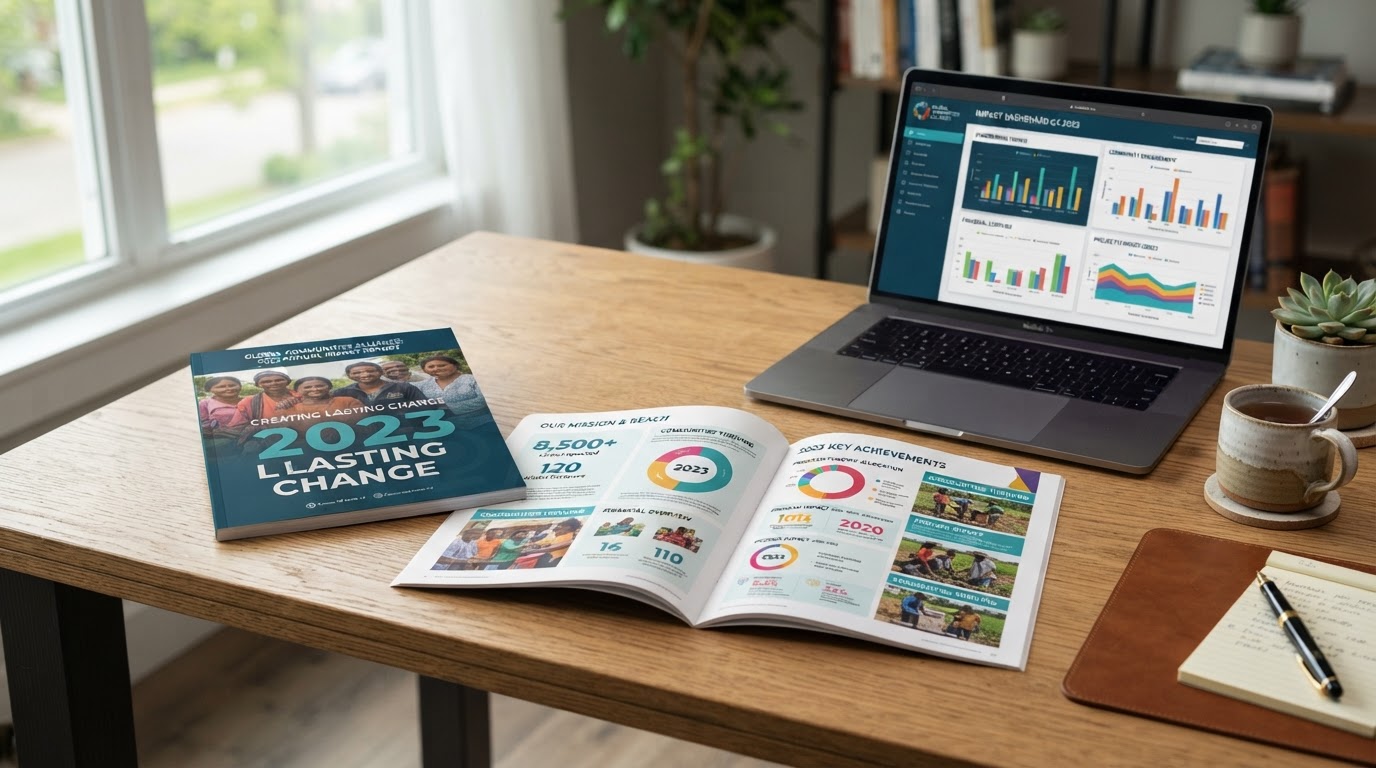
Ashley is clear that custom laser engraving is not a standalone product — it is a component of the stewardship system we build for every client, alongside the stewardship plans and impact reporting that anchor donor relationships over time. The engraved recognition is the physical touchpoint in a stewardship sequence that also includes the thank-you call, the impact update, the annual report, and the next ask. Each touchpoint reinforces the others. The engraved plaque on the wall is what the donor sees when they visit; the impact report is what they read at home; the personal note is what they keep. A stewardship system with all three is far more durable than any single element alone.
This is why Damon positions engraving inside our broader Impact & Recognition services rather than treating it as merchandise. The goal is not to sell plaques. The goal is to build the durable recognition infrastructure that makes donors, staff, and volunteers feel permanently valued — because permanently valued people renew, stay, and return. The engraving is the most visible part of a system that is otherwise invisible, and visibility is exactly what makes it work.
A thank-you is a moment. An engraving is a monument to the moment. Donors remember monuments. They forget moments. Build the monument. — Damon Boswell
The Cost-Benefit That Boards Understand
Ashley closes every engraving conversation with the arithmetic that makes boards comfortable, because recognition spending is the line item most likely to be questioned. The 2026 donor-wall research places engraved recognition at a modest per-unit cost for broad participation and a higher but still contained range for bespoke major-gift pieces. Against that cost sits the retained donor, the retained staff member, and the retained volunteer — each of whom costs multiples of that engraving to replace. A single retained major donor, kept by a recognition program that made them feel permanently seen, returns the cost of an entire recognition wall. The math is not subtle, and once a board sees it, the line item stops being questioned and starts being funded.
Make Appreciation Permanent
If your donors receive thank-you emails but nothing they can hold, your fundraising staff hit milestones with no mark of them, and your volunteers gave hundreds of hours with no tangible record, the problem is not ingratitude. The problem is the absence of a recognition system that makes appreciation permanent. Ashley and Damon Boswell build custom laser engraving programs for donor, fundraising staff, and volunteer appreciation as part of ASAP Grants' Impact & Recognition services. Schedule a free consultation, and let us make the gratitude your organization feels into something your supporters can see, hold, and remember.
Ashley & Damon Boswell
Founding Partners, ASAP Grants
Ashley & Damon Boswell are the founding partners of ASAP Grants, a nationwide professional firm specializing in 501(c)(3) formation, grant writing, and holistic fundraising for nonprofits. Since 2010, they have maintained a 100% success rate on nonprofit filings and helped organizations across all fifty states secure sustainable funding.