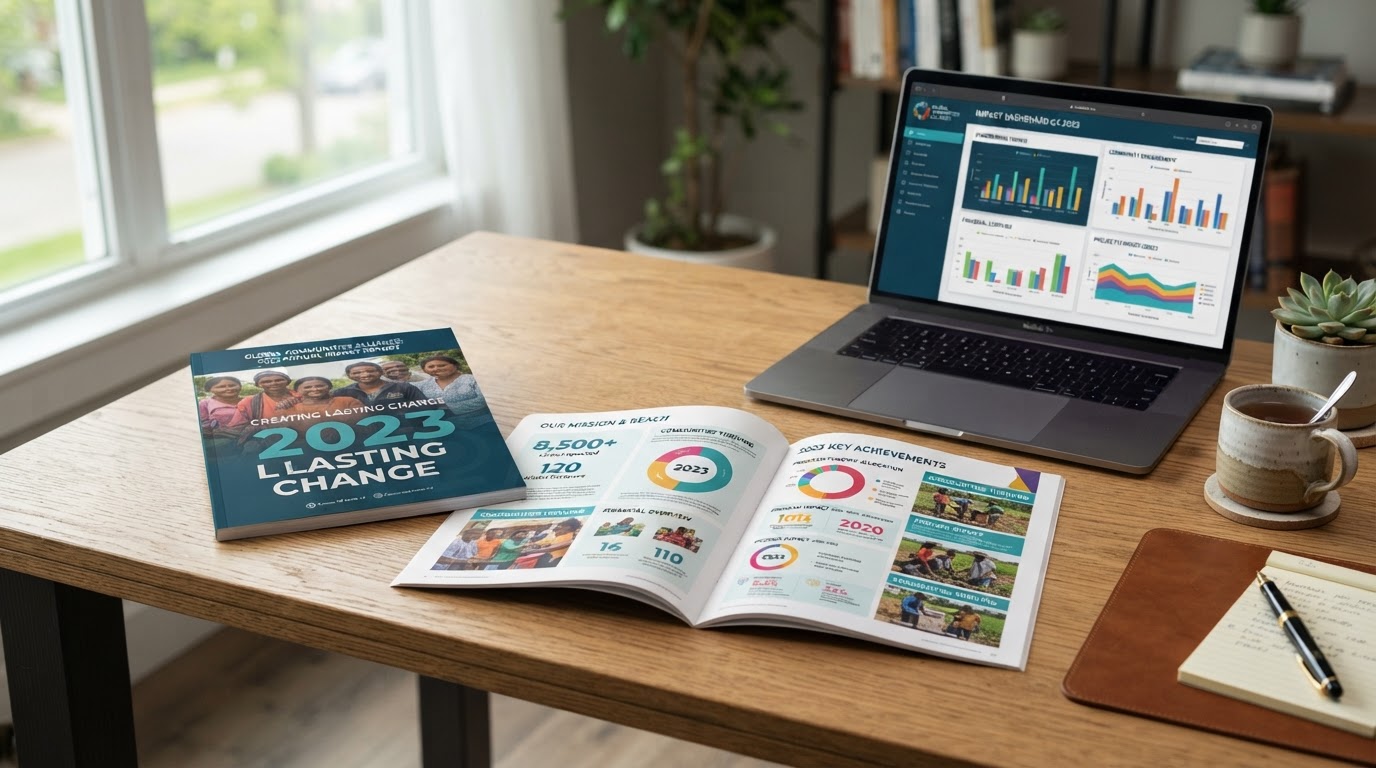
Damon Boswell opens every annual report engagement at ASAP Grants with a question that exposes the gap between organizations that build trust and organizations that file documents. He asks the executive director what the annual report is for. Most answer that it is a requirement — something the board expects, the auditors reference, the funders might check. Damon's framing is unsentimental: an annual report treated as a requirement is an annual report that costs money and builds nothing, while an annual report treated as a trust engine is the single most powerful donor-cultivation document the organization produces. The difference is not the content. The difference is the intent, and the intent shapes every decision from the first headline to the final financial page.
In this article, Damon and Ashley Boswell walk through the annual and impact report architecture we build for ASAP Grants clients — the narrative spine, the data visualization, the honesty discipline, the donor recognition, and the digital-first design that turns a compliance document into a trust-building instrument. This sits inside our Annual & Impact Reports service, and it is the document that separates organizations donors trust from organizations donors tolerate.
Why 2026 Made the Impact Report the Trust Engine
The case for a rigorous impact report is no longer aspirational; it is donor expectation. The Constructive 2026 nonprofit annual report research, analyzing the best digital reports in the sector, found that nonprofits face increasing pressure to demonstrate impact and clearly communicate how their work makes a difference. The report is no longer a list of achievements — it is the story of impact that inspires confidence in the work ahead. The Redstart Creative 2026 annual report trends research reinforces the point: the best reports combine compelling storytelling, thoughtful design, data visualization, accessibility, and digital-first delivery. An organization that produces a PDF of bullet points and a financial summary is an organization meeting the minimum standard of a decade ago, and the donors of 2026 expect more — because the organizations competing for their support are delivering more.
Ashley frames the shift for every board we work with: the annual report is not a retrospective. It is a forward-looking trust argument, because the donor who reads the report is deciding whether to give again, and the report that convinces them is the report that shows not just what was done but why it mattered and what comes next. The Clear Impact 2026 impact reporting guidance is explicit that storytelling brings impact to life, making it easier for stakeholders to understand how the work makes a difference — and a stakeholder who understands the difference is a stakeholder who funds the difference. Damon's rule is that the annual report is the document a donor reads before they decide whether to give again, and an organization that does not treat it as the decision document it is has left its retention strategy to chance.
The ASAP Grants Impact Report Architecture
Damon builds every impact report around a five-layer architecture that moves an organization from a compliance document to a trust engine. Each layer has a purpose, because an impact report without narrative discipline is a report that buries the story a donor needs under the data a staff member compiled.
1. The Narrative Spine
The first layer is the one most reports skip, and Ashley treats it as the foundation that makes everything else legible. Before any data is presented, we build a narrative spine — the throughline that connects the year's work to the mission, the mission to the outcomes, and the outcomes to the donor's role in making them possible. The Clear Impact 2026 guidance recommends selecting a storytelling pattern — before-and-after stories, case studies, or specific success stories — that humanizes the data and makes the report engaging. A report that opens with statistics has lost the donor before the statistics land; a report that opens with a story the statistics then prove has given the donor a reason to read the statistics. Damon's rule is that the narrative spine is not decoration on top of the data. It is the structure the data hangs on, and a report without it is a report a donor scans and closes.
2. The Data Visualization
Once the narrative exists, Damon builds the data visualization that makes the impact legible at a glance. The Constructive 2026 research, analyzing reports from organizations like Code for America and World Vision, found that the best reports use data visualization to guide readers through the impact without overwhelming them — clean design, subtle motion, and numbered highlights that make key achievements easy to scan. The discipline is that the data serves the story, not the reverse. A report with fifty charts is a report that buries the narrative; a report with five charts, each tied to a narrative beat, is a report that proves the story the donor is reading. Ashley's rule is that every chart in the report answers a question the donor is already asking — how many people were served, how much was raised, what changed — and a chart that does not answer a donor's question is a chart that occupies space without earning it.
3. The Honesty Discipline
This is the layer where most reports fail, and Damon treats it as the discipline that separates a report that builds trust from a report that erodes it. The Bloomerang 2026 annual report guidance is explicit: honesty is the best policy, especially in the annual report. A report that only celebrates successes and never acknowledges challenges is a report a sophisticated donor does not trust, because every nonprofit had a hard year somewhere, and a report that claims otherwise signals that the organization is managing its image rather than reporting its reality. Ashley builds every report with a candid section — what did not work, what the organization learned, what it will do differently — because the honesty that acknowledges a challenge is the honesty that makes the celebration of a success credible. Damon's framing is that a donor who trusts an organization's honesty will forgive its challenges, and a donor who suspects an organization's reporting will doubt its successes.
4. The Donor Recognition
Ashley builds donor recognition into every report, because the report is the document the donor reads to confirm that their gift mattered. The recognition is not a donor list appended to the back — it is a woven acknowledgment that the impact on the page was made possible by the people who gave. The Constructive 2026 research found that the best reports connect the impact to the community that produced it, making the reader feel that their contribution is part of the story rather than separate from it. Damon's rule is that a donor who reads a report about impact they funded and does not see themselves acknowledged is a donor who feels taken for granted, and a donor who feels taken for granted is a donor who does not give again. The recognition is not gratitude — it is retention, expressed in print.
5. The Digital-First Design
The final layer is the one that determines whether the report is read at all, and Damon insists on it for every engagement. The Redstart Creative 2026 research is explicit that the best reports are digital-first — accessible, interactive, and designed for the screen the donor will actually read it on. A PDF designed for print and emailed as an attachment is a report most donors never open; a digital report with navigation, accessibility, and mobile responsiveness is a report a donor can engage with wherever they are. The Constructive 2026 research highlighted organizations like DigDeep and Khan Academy that built immersive digital experiences, but also noted that not every organization needs a microsite — a clear, well-structured report that prioritizes impact and outcomes is exactly what many nonprofits need. Ashley's rule is that the format serves the reader, not the organization, and a report designed for the organization's convenience rather than the donor's engagement is a report that fulfills its requirement and fails its purpose.
A report that only celebrates is a report a donor does not trust. A report that acknowledges the hard parts is a report a donor believes — and a donor who believes gives again. — Damon Boswell
The Storytelling-With-Numbers Discipline
Ashley builds every report around what the GrowthForce 2026 guidance calls the discipline of letting numbers tell a story. The Clear Impact 2026 research recommends weaving a narrative that connects metrics and achievements to the organization's broader mission, because storytelling brings impact to life and makes it easier for stakeholders to understand how the work makes a difference. The practical application is that every statistic in the report is presented in context — not 'we served 500 families' but 'we served 500 families, a 23% increase over last year, because the housing program expanded into two new neighborhoods, which was made possible by the $200,000 grant from the Community Foundation that you, our donors, helped us secure.' The number is the same. The story is different. And the donor who reads the story understands not just what was done but how their gift contributed to it, which is the understanding that produces the next gift. Damon's framing is that a number without a story is a fact, and a fact does not produce a donation — a story does.
Why Most Annual Reports Fail
Damon closes every engagement by naming the three failures that sink annual reports even when the organization's work is strong.
- The compliance failure: the organization produces the report to satisfy a requirement — the board, the auditor, the funder — and treats it as a checkbox rather than a trust engine. The report is filed, not read, and the donor-cultivation opportunity it represents is wasted entirely.
- The celebration-only failure: the report celebrates every success and acknowledges no challenge, producing a document a sophisticated donor does not trust. A report that claims a perfect year is a report that signals image management, and a donor who senses image management doubts everything else in the document.
- The data-without-story failure: the report is full of charts and statistics with no narrative connecting them, so the donor is presented with numbers but no reason to care about them. A chart that does not answer a question the donor is asking is a chart that occupies a page without earning a reader.
Build the Trust Engine Before You Need the Renewal
The most common annual report failure Ashley sees is not a lack of impact — the organizations are doing the work. The failure is the assumption that the impact speaks for itself, that a donor who gave will see the results without the organization telling the story, and that the annual report is a formality rather than the document that determines whether the donor gives again. An organization does extraordinary work, files a report that lists the activities, and then wonders why donor retention is below the sector average — when the report that could have built the trust that drives retention was treated as a compliance exercise. Damon's rule is that the annual report is built before the renewal ask, not after it, because the report is the argument for the renewal, and a renewal ask without a trust-building report behind it is an ask that depends on the donor's memory rather than the organization's evidence.
This is also why Damon treats the impact report as a governance discipline, not just a marketing document. The board that understands that the report is the organization's public accountability — that it must be honest, that it must be clear, and that it must connect the donor to the impact — plans differently. It invests in the report's quality, it demands honesty in its content, and it treats the report as the trust instrument it is. An organization that builds that understanding into its board builds its own credibility, and an organization that does not is one report cycle away from a donor base that has forgotten why they gave in the first place.
Turn the Report Into the Renewal
If your annual report is a compliance document, celebrates only successes, and presents data without a story, the problem is not your impact. The problem is the absence of a report that turns your impact into the trust that drives donor renewal. Damon and Ashley Boswell build complete annual and impact reports — narrative spine, data visualization, honesty discipline, donor recognition, and digital-first design — as part of ASAP Grants' Annual & Impact Reports service. Schedule a free consultation, and let us build the report that turns your compliance document into the trust engine your donors fund.
Damon & Ashley Boswell
Founding Partners, ASAP Grants
Ashley & Damon Boswell are the founding partners of ASAP Grants, a nationwide professional firm specializing in 501(c)(3) formation, grant writing, and holistic fundraising for nonprofits. Since 2010, they have maintained a 100% success rate on nonprofit filings and helped organizations across all fifty states secure sustainable funding.