Ashley and Damon Boswell begin every stewardship conversation at ASAP Grants with a number that should alarm every executive director in the sector: according to AFP's Fundraising Effectiveness Project, overall donor retention sits near 43%, and first-time donor retention is near 19%. That means more than eight out of every ten donors who give to your organization for the first time will never give again. They are not lost to a rival charity. They are lost to silence — to the absence of a deliberate, written plan to thank them, inform them, and invite them back. Damon calls stewardship the highest-leverage, most underfunded function in nonprofit fundraising today, and he is right.
In this article, Damon and Ashley walk through the stewardship plan architecture we build for ASAP Grants clients — the segmentation, communication cadence, recognition systems, and measurement that turn a one-time gift into a lifelong partnership.
What a Stewardship Plan Actually Is
A stewardship plan is not a thank-you note. Ashley is precise about this distinction: a thank-you note is a moment. A stewardship plan is a system — a written, documented strategy that defines how every donor is acknowledged, informed, recognized, and re-engaged based on their giving level, history, and relationship to the organization. It answers four questions for every donor: when will we thank them, how will we inform them, how will we recognize them, and when will we invite them back.
Without a plan, stewardship is reactive and inconsistent — it happens when someone remembers, and it does not happen when they forget. With a plan, stewardship becomes a reliable, measurable function that compounds donor loyalty year over year. That is the difference between a 19% first-time retention rate and a 60% one.
The Economics of Retention
Damon walks every client through the math, because the math is what makes stewardship the obvious investment. Acquiring a new donor costs significantly more than retaining an existing one — sector estimates place the cost of acquisition at five to seven times the cost of retention. A donor who gives $100 once and is never steward back costs the organization more than they gave, once acquisition costs are factored in. A donor who gives $100 and is retained for five years at an upgraded level may contribute $1,500 or more over the relationship.
The leverage is extraordinary: improving first-time donor retention from 19% to just 30% — still below the sector average for repeat donors — can increase lifetime revenue by more than 50% without acquiring a single new donor. Ashley's framing is simple: you do not have a fundraising problem. You have a retention problem disguised as a fundraising problem.
Segment Donors by Relationship, Not Just Dollar Amount
Ashley builds every stewardship plan around donor segmentation — because a one-size-fits-all approach guarantees that every donor receives either too little or too much attention. ASAP Grants segments donors into tiers, each with a defined stewardship protocol:
- First-time donors — who receive an immediate, personalized acknowledgment, a welcome series introducing the mission, and a second-gift invitation within 90 days, before the retention cliff.
- Recurring and monthly givers — who receive quarterly impact updates, an annual recognition, and an upgrade conversation timed to their giving anniversary.
- Mid-level donors ($1,000–$5,000) — who receive a personal thank-you call from a board member, a mid-year impact report, and an invitation to a cultivation event.
- Major gift donors ($5,000+) — who receive a personalized stewardship plan with named reporting, executive-director-level communication, and at least two in-person touches per year.
- Lapsed donors — who receive a sincere reactivation narrative rather than a generic solicitation, acknowledging the gap without guilt.
The segmentation is not bureaucratic — it is relational. Damon's principle is that every donor should feel that the organization knows who they are, remembers what they gave, and can tell them what their gift accomplished. That feeling is what retention is made of.
The Acknowledgment Window: Speed Is Gratitude
Ashley's first stewardship rule is non-negotiable: every gift is acknowledged within 48 hours. The data supports the urgency — timely, sincere gratitude is one of the strongest predictors of repeat giving. A donor who waits two weeks for a receipt begins to wonder whether their gift mattered. A donor who receives a personalized acknowledgment within two days feels seen.
ASAP Grants builds acknowledgment workflows that fire automatically — a confirmation, a receipt, and a personalized note — so that no donor ever wonders whether their gift was received. For gifts above a defined threshold, we add a handwritten note from a board member or the executive director, because the research is clear that personal, analog touches dramatically outperform generic digital acknowledgments in building loyalty.
Impact Reporting: Show, Do Not Tell
Damon structures stewardship communication around impact, not activity. Donors do not want a list of things the organization did. They want to know what their specific gift made possible. ASAP Grants builds donor-centered impact reporting that ties a gift amount to a concrete outcome: 'Your gift of $250 provided three weeks of mentorship for a young person in our program.'
This is where our Impact & Recognition services intersect directly with stewardship. Ashley builds annual and impact reports that are not organizational brag sheets but donor stewardship documents — designed to make every reader feel that their contribution was the reason the impact happened. Personalized thank-you videos featuring staff, board members, or program participants dramatically outperform generic acknowledgments, and we build them into the stewardship calendar at defined intervals.
Recognition That Deepens, Not Embarrasses
Ashley is thoughtful about recognition, because poorly designed recognition can alienate as easily as it can delight. Some donors want their name on a wall. Others would be mortified by it. ASAP Grants builds recognition systems that respect donor preference — offering public, semi-public, and anonymous recognition tracks, and asking donors directly how they wish to be recognized.
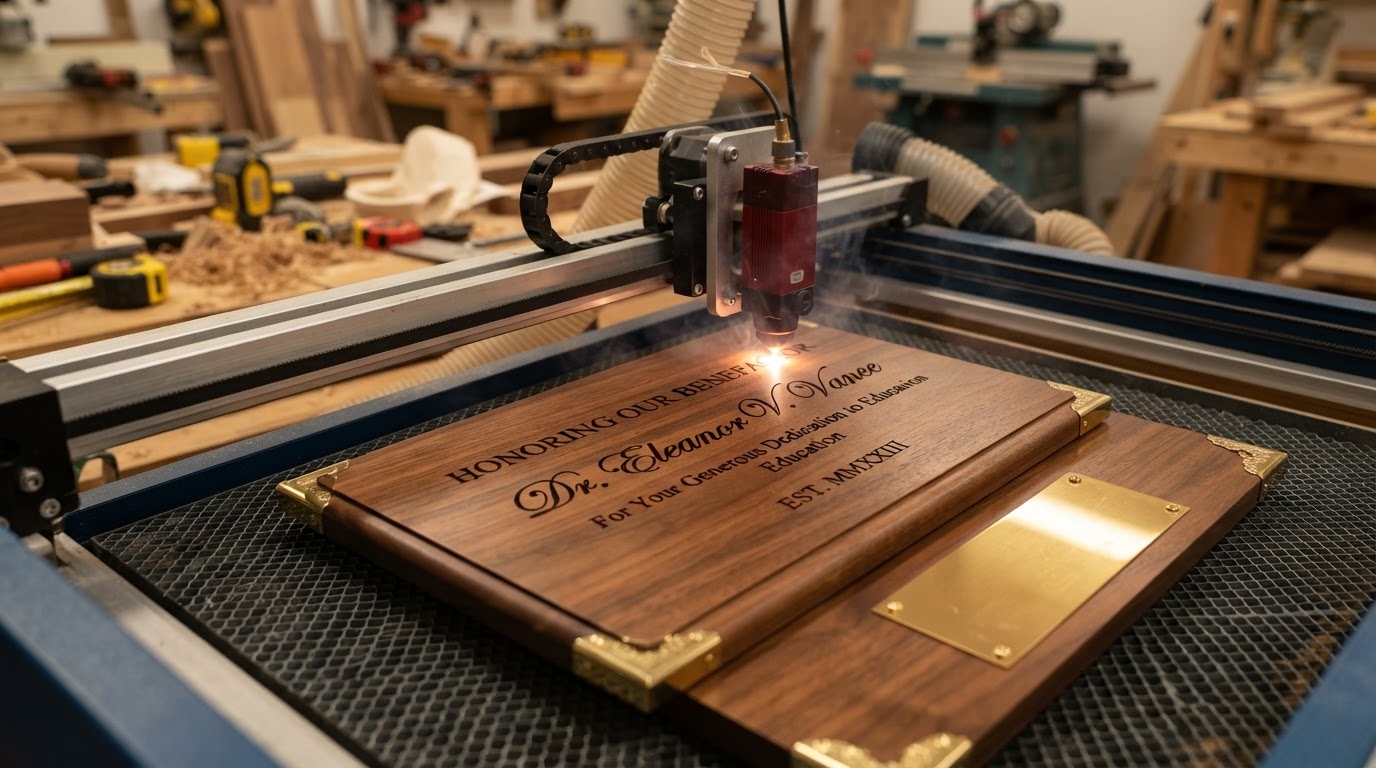
This is also where our Custom Laser Engraving service becomes a stewardship tool, not a merchandise line. Damon designs engraved recognition pieces — for donors, fundraising staff, and volunteers — that are presented at meaningful moments: a five-year giving anniversary, a campaign milestone, a volunteer's retirement. A tangible, personalized object of appreciation lands differently than a certificate. It says: we saw you, we remember you, and we made something for you specifically.
Stewardship is not what you do after the ask. It is the reason the next ask succeeds. — Damon Boswell
The Stewardship Calendar
Damon builds every stewardship plan as a 12-month calendar — a documented schedule of touches for every donor tier, so that stewardship happens by design rather than by memory. A typical calendar includes an immediate acknowledgment, a 30-day welcome touch for new donors, a quarterly impact update, a mid-year personal call for mid-level and major donors, an annual recognition moment, and a year-end invitation that references the donor's prior giving.
The calendar is not a suggestion — it is a commitment, assigned to named owners, tracked in the CRM, and reviewed monthly. Stewardship that is not assigned and measured does not happen. Ashley has audited too many organizations where the stewardship intention was genuine but the execution was invisible because no one owned it and no one measured it.
Measure Retention as a Revenue Metric
Ashley builds retention dashboards into every stewardship plan, because what is not measured does not improve. We track overall retention rate, first-time donor retention, repeat donor retention, average donor lifespan, upgrade rate, and revenue per donor over time. These are not vanity metrics — they are the leading indicators of whether the stewardship plan is working before the annual appeal numbers confirm or deny it.
The sector benchmark gives urgency to the measurement: with overall retention near 43% and first-time retention near 19%, any organization that is not actively measuring and improving these numbers is, by default, accepting the loss of more than half its donor base every year. Damon's position is firm: a stewardship plan without a retention dashboard is a hope, not a strategy.
Build Your Stewardship Plan Before You Need It
The most expensive moment to discover you have no stewardship plan is the moment you realize your donor base is shrinking. Ashley and Damon Boswell build complete stewardship plans — segmentation, acknowledgment workflows, impact reporting, recognition systems, 12-month calendars, and retention dashboards — as part of ASAP Grants' Impact & Recognition services. Schedule a free consultation, and let us turn your first-time donors into the lifelong partners your mission depends on.
Ashley & Damon Boswell
Founding Partners, ASAP Grants
Ashley & Damon Boswell are the founding partners of ASAP Grants, a nationwide professional firm specializing in 501(c)(3) formation, grant writing, and holistic fundraising for nonprofits. Since 2010, they have maintained a 100% success rate on nonprofit filings and helped organizations across all fifty states secure sustainable funding.