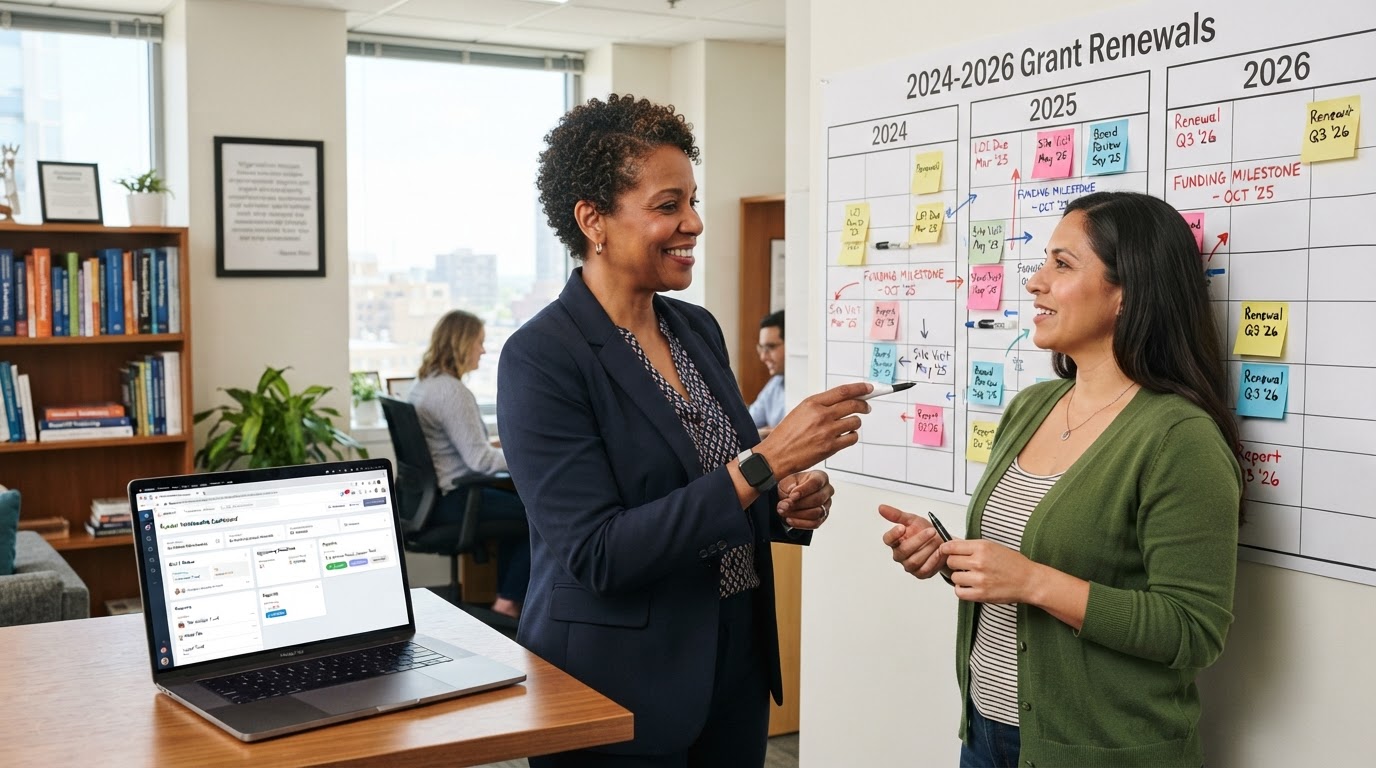
Damon Boswell opens every grant renewal engagement at ASAP Grants with a question that reframes how grant teams think about the relationship after the award. He asks the team to describe what they did in the 90 days after their last grant was awarded. Most teams describe the program — the staff they hired, the activities they launched, the beneficiaries they enrolled. None of that is wrong, Damon says, but none of it is the renewal. The renewal is the cultivation of the funder relationship that begins the day the check arrives, and the team that treats the award as the finish line is the team that arrives at the renewal deadline with a funder who has not heard from them in eleven months and feels like a stranger being asked for money by an organization they barely remember funding. Damon's framing is unsentimental: a grant renewal is not a second proposal — it is the product of a relationship that was either built or neglected in the twelve months between the award and the ask.
In this article, Damon and Ashley Boswell walk through the grant renewal and multi-year funding system we build for ASAP Grants clients — the post-award cultivation calendar, the reporting that builds funder confidence, the relationship milestones that make the renewal a continuation rather than a cold ask, the multi-year case that converts a one-year grant into sustained funding, and the renewal measurement that turns a single award into a compounding funder portfolio. This sits inside our Grant Writing & Reporting service, and it is the discipline that separates an organization that wins a grant from an organization that builds a funder.
Why 2026 Made the Renewal the Highest-Leverage Moment
The case for a rigorous renewal discipline is no longer aspirational; it is retention arithmetic. The AFP Fundraising Effectiveness Project's 2026 reporting places overall donor retention near 43% and first-time donor retention near 19% — which means more than four in five first-time donors do not give a second gift, and the funder who gave a first grant and is not cultivated for the renewal lapses into the same attrition curve. The FundEasy 2026 recurring giving benchmarks add the frequency data: monthly donor retention rates average 71% after 12 months and 54% after 24 months, and the principle generalizes — the funder who is engaged with regularity retains at dramatically higher rates than the funder who is contacted only at the renewal deadline. The Instil 2026 nonprofit fundraising trends research reinforces the convergence: teams are examining retention rate, donor lifetime value, and upgrade rate to guide multi-year strategies, because the renewal is not a single event but a managed relationship that produces lifetime value from a single award. Damon's point is that the grant that is not renewed is a grant that cost as much to win as a multi-year grant and produced one year of revenue, and the organization that does not manage the renewal is the organization that pays full acquisition cost for every year of funding.
Ashley frames the economics for every board we work with: the cost of renewing an existing funder is a fraction of the cost of acquiring a new one, and the funder who renews is the funder who may become a multi-year partner, a major donor, and an advocate. An organization that wins ten new grants a year and renews three is growing its funder base by three. An organization that wins the same ten and renews seven is growing its funder base by seven — from the same acquisition spend — because the renewal multiplies the return on every acquisition investment. Damon's rule is that acquisition is the cost of the first year and renewal is the return on every year after, and the organization that does not invest in the renewal is the organization that pays the acquisition cost every year for the same revenue.
The ASAP Grants Renewal Architecture
Damon builds every grant renewal program around a five-layer architecture that moves an organization from a one-time award to a multi-year funding relationship. Each layer has a purpose and a cadence, because a renewal program without cadence always degrades into a renewal request that arrives eleven months too late.
1. The Post-Award Cultivation Calendar
The first layer is the one most organizations never build, and Ashley treats it as the foundation that makes every subsequent layer possible. The cultivation calendar is a structured 12-month engagement plan that begins the day the grant is awarded — not the day the renewal is due. Within the first 30 days, a thank-you communication that goes beyond the acknowledgment and reports the specific impact the grant will make. Within the first 90 days, a progress update that shows the grant in action. At the six-month mark, a midpoint report or a brief check-in that demonstrates the organization is managing the grant with discipline. At the nine-month mark, a result-oriented story that proves the program is working. And at the ten-month mark — before the renewal deadline — a renewal conversation that arrives as the natural continuation of a year-long relationship rather than a cold request from an organization the funder has not heard from since the award letter. Damon's rule is that the renewal is won in the eleven months before the ask, not in the proposal that accompanies it, because the funder who has been cultivated for a year receives the renewal as a continuation and the funder who has not receives it as an interruption.
2. The Reporting That Builds Funder Confidence
Once the cultivation cadence is established, Damon builds the reporting discipline that turns each report into a confidence-building instrument rather than a compliance formality. The Instil 2026 fundraising trends research emphasizes that teams examine metrics like retention rate, donor lifetime value, and upgrade rate to guide multi-year efforts — and the same rigor applies to grant reporting. A report that says 'we served 200 youth' is a compliance document. A report that says 'we served 200 youth, 87% of whom showed measurable improvement on our pre- and post-program assessment, and the 13% who did not improve were concentrated in the first cohort where we identified a curriculum gap we have since addressed' is a confidence document that proves the organization is not just delivering the program but learning from it. Ashley's rule is that every report is a renewal argument in disguise, because the funder who reads a report that demonstrates rigor and outcomes is the funder who renews without requiring the organization to re-prove itself, and the report that is a compliance formality is the report that makes the renewal feel like a first-time ask.
3. The Relationship Milestones
This is the layer where most renewal programs quietly fail, and Damon treats it as the human discipline that a calendar and a report cannot replace. The relationship milestones are the personal touchpoints that transform a funder from a grantor into a partner — a site visit invitation at the six-month mark, a phone call from the executive director rather than an email from the grant writer, a personal note when a program milestone is reached, and an invitation to see the program in action rather than read about it in a report. The Instil 2026 research on multi-year strategies emphasizes that renewal is not a transactional event but a relationship that produces lifetime value, and relationships are built through the personal touches that no report can replicate. The funder who has visited the program, met the beneficiaries, and heard the executive director describe the vision is the funder who renews as a partner, and the funder who has received only reports and renewal requests is the funder who renews as a transaction — if they renew at all. Ashley's rule is that the milestone is the moment the funder stops being a funder and starts being a believer, and the renewal that comes from a believer is the renewal that becomes multi-year.
4. The Multi-Year Case
The fourth layer is the one that converts a renewal into sustained funding, and Ashley treats it as the strategic argument that the single-year renewal does not make. The multi-year case is the proposal that does not ask for one more year — it asks for a partnership that scales the impact the first year proved was possible. The case is built on the outcomes the first grant produced, the learnings the organization derived, the growth the program is positioned for, and the sustained relationship that multi-year funding enables. The Instil 2026 research emphasizes that teams are building multi-year strategies around retention and lifetime value, and the multi-year case is the expression of that strategy in a renewal proposal. An organization that asks for a one-year renewal is asking the funder to decide again whether to fund the program. An organization that asks for a three-year commitment is asking the funder to invest in a trajectory the first year proved was real, and the funder who is offered a trajectory is the funder who funds the trajectory rather than re-deciding the grant. Damon's rule is that the single-year renewal asks for repetition and the multi-year case asks for growth, and the funder who is offered growth is the funder who grows with the organization instead of re-evaluating it every twelve months.
5. The Renewal Measurement
The final layer is the one that turns renewal from a hope into a managed metric, and Damon insists on it for every engagement. We track four core indicators: the renewal rate — the percentage of grants renewed, benchmarked against the retention curves the 2026 data maps; the multi-year conversion rate — the percentage of renewals that convert from single-year to multi-year commitments; the funder lifetime value — the cumulative funding a funder has provided over the relationship; and the funder relationship duration — how long, on average, a funder has been engaged. The funder lifetime value is the metric that reframes the entire program, because a funder who has given $50,000 over three years is not a $50,000 funder — they are a partner whose lifetime value is still growing, and the renewal strategy that manages lifetime value is the strategy that treats every funder as a long-term asset rather than a single-grant transaction. Damon's rule is that an organization that does not measure renewal is an organization that cannot manage it, and the 19% first-time retention figure is the default outcome for any organization that wins a grant and does not build the relationship that keeps it.
The grant is won on the proposal. The funder is kept on the relationship that begins the day the grant is awarded. — Damon Boswell
The Renewal as Multiplier
Ashley builds every renewal engagement around the multiplier effect the 2026 retention data makes visible. A grant won is one year of revenue. A grant renewed is two years of revenue from one acquisition investment. A grant renewed and converted to multi-year is three to five years of revenue from the same acquisition, plus the relationship equity that makes the funder an advocate, a major donor prospect, and a referral source for new funders. The FundEasy 2026 data on recurring retention — 71% at 12 months, 54% at 24 months — is the frequency principle applied to grant funders: the funder engaged with regularity retains, and the funder contacted only at the renewal deadline lapses. Damon's framing is that the renewal is not a fundraising activity — it is the multiplier that determines whether the acquisition investment compounds or evaporates, and the organization that treats the renewal as an afterthought is the organization that pays full acquisition cost for every single year of funding it ever receives.
The Three Renewal Failures
Damon closes every renewal engagement by naming the three failures that turn a won grant into a lapsed funder.
- The award-as-finish-line failure: the team celebrates the award and shifts entirely to program delivery, and the funder relationship goes dormant for eleven months until the renewal deadline triggers a panic proposal. The funder who receives a renewal request from an organization they have not heard from since the award is the funder who feels like an ATM being asked for a second withdrawal by someone who never said thank you for the first, and the renewal that feels like a transaction is the renewal that does not renew.
- The compliance-report failure: every report the organization submits is a compliance formality that checks the boxes the funder required without demonstrating outcomes, learning, or the discipline that would make the funder confident in a renewal. The report that says 'we did what you funded' is the report that makes the renewal feel like a re-evaluation; the report that says 'here is what we did, here is what we learned, and here is how we are improving' is the report that makes the renewal feel like a continuation of a partnership that is getting better.
- The single-year-ask failure: the renewal asks for one more year, which asks the funder to re-decide whether to fund the program, and the funder who is asked to re-decide is the funder who may decide differently this time. The multi-year case that offers the funder a trajectory instead of a repetition is the case that converts the renewal from a repeated decision into a sustained commitment, and the organization that asks for one year every year is the organization that re-acquires the same funder every twelve months at the full cost of the first acquisition.
Build the Renewal Before the Award Cools
The most common renewal failure Ashley sees is not a lack of outcomes — the programs are often producing them. The failure is the absence of a system that cultivates the funder from the day of the award, reports with the rigor that builds confidence, creates the personal milestones that transform a grantor into a partner, makes the multi-year case that converts a renewal into sustained funding, and measures the renewal as a managed asset rather than an annual scramble. An organization that wins a grant and neglects the relationship for eleven months is an organization that arrives at the renewal with a funder who has cooled — and a cooled funder is a funder one competing organization away from lapsing. Damon's rule is that the renewal is built in the eleven months before the ask, because the funder who has been cultivated all year receives the renewal as the natural next step in a relationship that is already growing, and the funder who has not is the funder the organization has to win again from scratch.
This is also why Damon treats the renewal as a governance discipline, not just a grant-writing task. The board that understands that overall retention is near 43%, that first-time retention is near 19%, and that the renewal multiplies every acquisition investment plans differently — it invests in the cultivation calendar before the award, it demands reporting that builds confidence, and it treats the funder relationship as a multi-year asset rather than a single-grant transaction. An organization that builds that understanding into its leadership builds a funder portfolio that compounds, and an organization that does not is one renewal season away from discovering that the grants it thought it had were one-year relationships that were never built into anything more.
Turn the Grant Into the Funder
If your grants are won and then neglected until the renewal deadline, your reports are compliance formalities, and your renewals ask for one more year without a multi-year case, the problem is not your programs. The problem is the absence of a renewal system that cultivates the funder from the award, reports with rigor, creates relationship milestones, builds the multi-year case, and measures the funder as a lifetime asset. Damon and Ashley Boswell build complete grant renewal and multi-year funding programs — post-award cultivation calendar, confidence-building reporting, relationship milestones, multi-year case, and renewal measurement — as part of ASAP Grants' Grant Writing & Reporting service. Schedule a free consultation, and let us build the renewal system that turns every grant into a funder and every funder into a multi-year partner.
Damon & Ashley Boswell
Founding Partners, ASAP Grants
Ashley & Damon Boswell are the founding partners of ASAP Grants, a nationwide professional firm specializing in 501(c)(3) formation, grant writing, and holistic fundraising for nonprofits. Since 2010, they have maintained a 100% success rate on nonprofit filings and helped organizations across all fifty states secure sustainable funding.