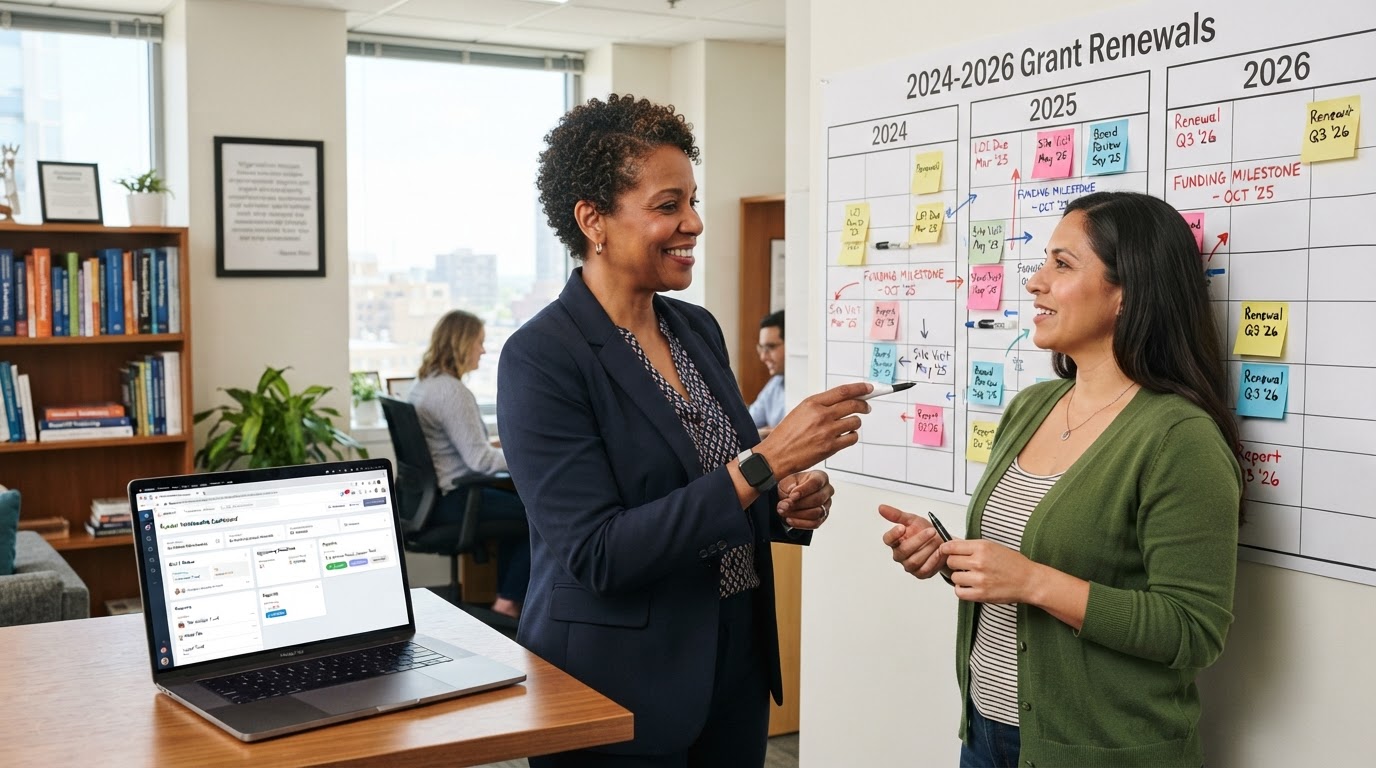
Damon Boswell opens every grant budget engagement at ASAP Grants with a question that exposes the gap between organizations that win grants and organizations that almost win them. He asks the grant writer to explain, line by line, why each number in the budget is what it is. Most writers can describe what the line is for — personnel, travel, supplies — but cannot justify why the number is the number. That gap is the budget narrative, and Damon's framing is unsentimental: a funder who cannot understand your budget cannot defend your budget to their board, and a budget that cannot be defended is a budget that gets declined. The program was not the problem. The numbers were not the problem. The narrative that connected them was missing.
In this article, Damon and Ashley Boswell walk through the grant budget narrative architecture we build for ASAP Grants clients — the line-item justification, the cost basis, the alignment with the program narrative, and the funder-confidence discipline that turns a spreadsheet into a funded proposal. This sits inside our Grant Writing & Reporting service, and it is the document that separates a proposal a reviewer approves from one a reviewer admires and declines.
Why 2026 Made the Budget Narrative Non-Negotiable
The case for a rigorous budget narrative is no longer aspirational; it is competitive reality. CharityEngine's 2026 budget narrative research is explicit: a clear budget narrative turns figures into a coherent financial strategy, showing how each requested dollar contributes to the project's outcomes. Funders in 2026 are scrutinizing budgets more carefully than ever, because the funding environment is tighter and every award is being defended to a board that wants to know the money is being spent wisely. A proposal with a compelling program narrative and an unexplained budget is a proposal that fails on the second read — the program reviewer loves it, the finance reviewer cannot justify it, and the finance reviewer's caution wins. Damon has read the decline letters. They almost never say the program was weak. They say the budget was unclear, the costs were not justified, or the relationship between the budget and the program was not evident.
Ashley frames the shift for every team we work with: the budget narrative is not an appendix to the proposal. It is the proposal's financial argument, and a proposal without a financial argument is a request, not a case. The Candid 2026 nonprofit budget guidance reinforces the point — a strong budget is a credible budget, and credibility is built through transparency about how every number was derived. An organization that presents a budget with round numbers and no justification signals that the budget was estimated, not calculated, and a funder who senses estimation declines. Damon's rule is that every number in a grant budget should be traceable to a source — a salary scale, a vendor quote, a historical cost, a market rate — and the budget narrative is the document that makes the trace visible.
The ASAP Grants Budget Narrative Architecture
Damon builds every budget narrative around a five-layer architecture that moves an organization from a line-item spreadsheet to a defensible financial argument. Each layer has a purpose, because a budget narrative without structure is a budget narrative that buries the justification a reviewer needs under prose they will not read.
1. The Line-Item Justification
The first layer is the foundation, and Ashley treats it as non-negotiable. Every line item in the budget gets a written justification that answers three questions: what is this cost for, how was the amount calculated, and how does it directly support the program described in the narrative. The CharityEngine 2026 guidance is specific: a budget narrative explains each line item so a reviewer understands not just what the organization is spending but why the spending is necessary and reasonable. A personnel line that says 'Program Coordinator — $45,000' is a number. A personnel line that says 'Program Coordinator at 0.5 FTE, $45,000 annual salary, calculated at 50% allocation to this program based on the coordinator's responsibility for delivering the youth mentoring component described in Section 3' is a justification. The difference is the difference between a budget a reviewer questions and a budget a reviewer accepts.
2. The Cost Basis
Once the justification exists, Damon builds the cost basis that proves every number is real, not estimated. The Blue Avocado 2026 grant budgeting guidance emphasizes that funders want to see the math behind the budget — the salary scale, the fringe rate, the unit cost, the vendor quote. A travel line that says '$5,000' is a guess. A travel line that says '$5,000, calculated at 0.585/mile federal rate for an estimated 8,500 miles of program-related travel across 12 site visits' is a calculation a reviewer can verify and defend. Ashley's rule is that the cost basis is the credibility engine of the entire budget, because a funder who can trace a number to a source trusts the number, and a funder who cannot trace it assumes it was invented. The assumption of invention is the silent killer of grant proposals, and the cost basis is the defense against it.
3. The Program Alignment
This is the layer where most budget narratives fail, and Damon treats it as the connection that makes the whole document work. Every line item must be tied explicitly to a component of the program narrative — not generically to the program, but specifically to the activity, the outcome, or the deliverable the line supports. The LinkedIn 2026 guidance on budget narratives makes the point: a clear budget narrative turns figures into a coherent financial strategy, showing how each requested dollar contributes to the project. A supplies line tied to 'program supplies' is untied. A supplies line tied to 'curriculum materials for the 40-student after-school literacy program described in Section 3, calculated at $25/student for 40 students' is a line that a reviewer can map directly to the program they just read. Damon's framing is that the budget narrative is the bridge between the story and the numbers, and a bridge with a gap is a bridge a funder will not cross.
4. The Narrative Budget Format
Ashley builds the budget narrative in the format that funders can actually use, which is not always the format organizations default to. The University of Arkansas 2026 narrative budget template guidance recommends starting with the traditional line-item budget and then building the narrative alongside it — total income and expenses, breakdown by department or program, and administrative and fundraising costs clearly separated. The narrative budget format presents the financial information in prose that a non-financial reviewer can follow, alongside the line-item format that a financial reviewer needs. The dual format serves both audiences because a grant review committee almost always includes both a program reviewer who reads the story and a finance reviewer who reads the numbers, and a budget narrative that serves only one of them is a budget narrative that fails the other.
5. The Funder-Confidence Discipline
The final layer is the one that turns a budget narrative from a document into a trust-building instrument, and Damon insists on it for every engagement. The discipline is simple: the budget narrative should answer every question a funder could possibly ask before the funder asks it. If the funder will wonder why the executive director's salary is in the budget, the narrative explains the allocation. If the funder will wonder why indirect costs are 15%, the narrative justifies the rate. If the funder will wonder why travel is high, the narrative breaks down the mileage. Damon's rule is that a budget narrative that anticipates and answers every question builds confidence, and a budget narrative that leaves questions unanswered invites skepticism. The funder who finishes the budget narrative with no remaining questions is the funder who approves the grant, and the funder who finishes with questions is the funder who declines.
A funder does not fund your program. A funder funds their confidence in your program. The budget narrative is where confidence is built or lost. — Damon Boswell
The Three Budget Narrative Failures
Damon closes every engagement by naming the three failures that sink budget narratives even when the program is strong.
- The round-number failure: the budget is full of round numbers — $10,000, $5,000, $20,000 — with no calculation behind them. Round numbers signal estimation, and a funder who senses estimation assumes the budget was built to fit the ask rather than to reflect the real cost. Every number should be a calculation, and the narrative should show the math.
- The orphan-line failure: line items exist in the budget that are never mentioned in the program narrative, and program activities are described in the narrative that have no corresponding budget line. The budget and the narrative are telling two different stories, and a funder who notices the disconnect loses confidence in both.
- The unjustified-indirect failure: indirect costs are listed as a percentage with no explanation of what the percentage covers or how it was derived. Indirect costs are the line funders scrutinize most heavily, and an unjustified indirect rate is the line that most often triggers a decline. The narrative must explain what the indirect covers and why the rate is reasonable.
Build the Narrative Before the Reviewer Builds Their Doubt
The most common budget narrative failure Ashley sees is not a lack of program quality — the programs are often excellent. The failure is the assumption that the budget speaks for itself. An organization submits a compelling program narrative and a clean line-item budget, and assumes the funder will connect them. The funder does not connect them, because the funder is reviewing fifty proposals and has no time to reverse-engineer the relationship between the story and the numbers. The budget narrative is the document that does the connection for the funder, and an organization that leaves the connection to the funder's imagination is an organization that leaves the award to chance. Damon's rule is that the budget narrative is built before the proposal is submitted, not after the funder asks for clarification, because the funder who asks for clarification has already formed a doubt, and a doubt once formed is rarely fully reversed.
This is also why Damon treats the budget narrative as a governance discipline, not just a grant-writing task. The board that understands that every grant dollar must be justified, that indirect rates must be defensible, and that the budget and the narrative must tell the same story plans differently — it invests in financial clarity, it demands cost-basis documentation, and it treats the budget as the financial argument it is. An organization that builds that understanding into its culture builds its own credibility, and an organization that does not is one unjustified line item away from a decline it cannot explain.
Make the Numbers Tell the Story
If your grant budgets are full of round numbers, your line items are not tied to your program narrative, and your indirect costs are a percentage with no explanation, the problem is not your program. The problem is the absence of a budget narrative that turns your numbers into a defensible financial argument. Damon and Ashley Boswell build complete grant budget narratives — line-item justification, cost basis, program alignment, dual-format presentation, and funder-confidence discipline — as part of ASAP Grants' Grant Writing & Reporting service. Schedule a free consultation, and let us build the budget narrative that makes your numbers tell the story funders fund.
Damon & Ashley Boswell
Founding Partners, ASAP Grants
Ashley & Damon Boswell are the founding partners of ASAP Grants, a nationwide professional firm specializing in 501(c)(3) formation, grant writing, and holistic fundraising for nonprofits. Since 2010, they have maintained a 100% success rate on nonprofit filings and helped organizations across all fifty states secure sustainable funding.