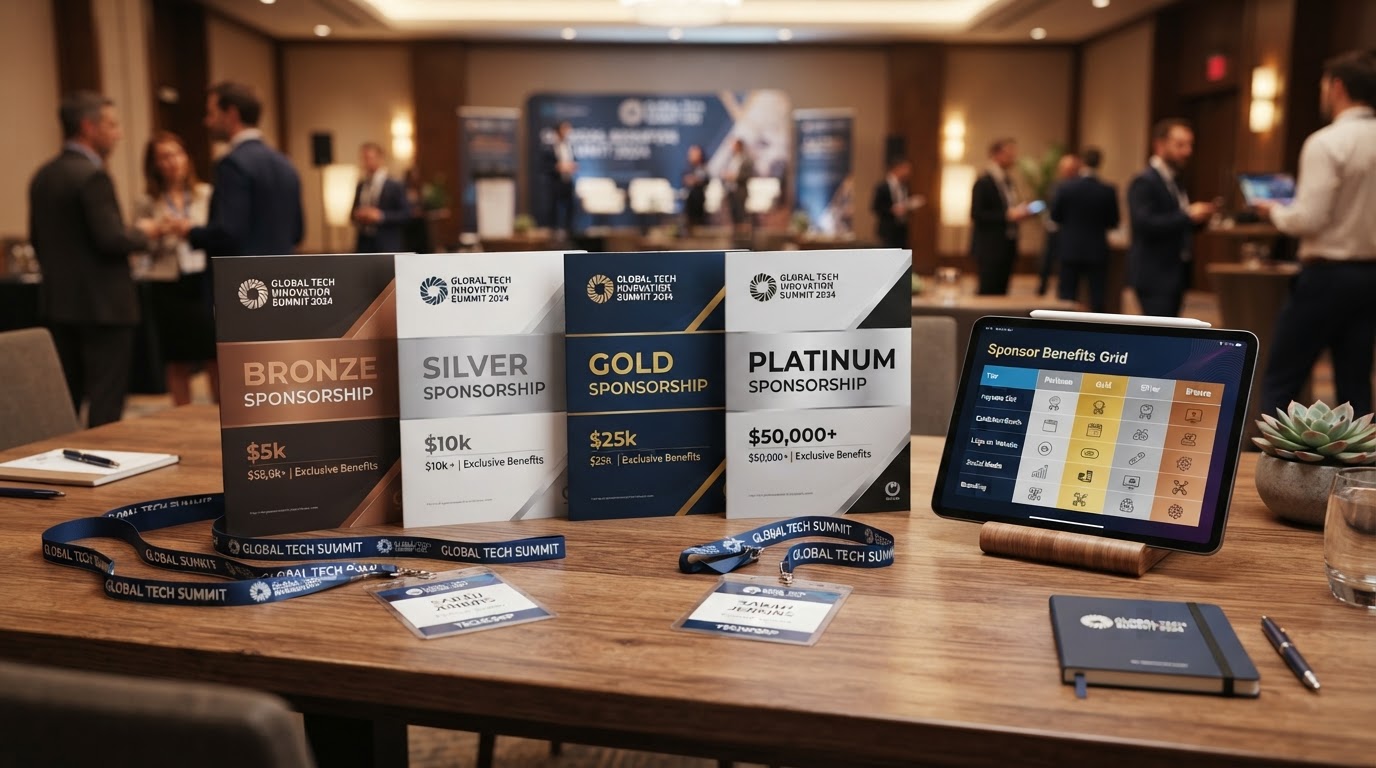
Damon Boswell opens every event sponsorship engagement at ASAP Grants with a question that exposes the gap between prospectuses that sell and prospectuses that sit unread. He asks the event team to describe their sponsorship tiers without looking at the document. Most teams can name the tier titles — Bronze, Silver, Gold, Platinum — but cannot describe what distinguishes one from the next in a way a sponsor would find compelling. The tiers blur, the benefits stack without differentiation, and the prospectus becomes a price list that asks the sponsor to figure out the value themselves. Damon's framing is unsentimental: a sponsor who cannot see the value of moving up a tier in five seconds is a sponsor who buys the bottom tier or nothing at all, and the prospectus that does not make the upgrade obvious is the prospectus that leaves money on the table at every level above the entry point.
In this article, Damon and Ashley Boswell walk through the event sponsorship prospectus architecture we build for ASAP Grants clients — the tier-count discipline, the pricing ratio that makes upgrades compelling, the benefits pyramid that separates visibility from engagement, the audience-data case that justifies the ask, and the fulfillment system that earns the renewal. This sits inside our Fundraising For Nonprofits and Sponsorships services, and it is the document that turns a sponsorship ask from a transaction into a partnership.
Why 2026 Made the Prospectus a Strategic Document
The case for a rigorous sponsorship prospectus is no longer aspirational; it is competitive design. The 2026 sector data is consistent across sources. The i4a 2026 event sponsorship research found that three to four tiers work best — providing clarity for sponsors and revenue potential without creating decision friction — while more than four tiers create confusion and fewer than three cap the revenue potential. The pricing guidance is equally specific: the top tier should be three to four times the price of the bottom tier, not ten times higher, because an extreme ratio makes the top tier feel unreachable and the bottom tier feel like a consolation prize. The Instrumentl 2026 sponsorship guidance reinforces the structure: the most common tiers are Bronze, Silver, Gold, and Platinum, each giving increasingly more appealing and exclusive benefits for a higher price, and the design should be eye-catching while aligning with the nonprofit's branding. Damon's point is that the prospectus is not a price sheet — it is a decision architecture, and the architecture that makes the choice obvious is the architecture that maximizes revenue at every tier.
Ashley frames the shift for every event team we work with: the sponsor is not buying visibility. The sponsor is buying access to an audience. The Sponsorship Collective's 2026 guidance, cited in the HelpYouSponsor research, is blunt — sponsorship is not about logo placement, it is about audience, and at least half of the sponsorship proposal should focus on audience data: demographics, interests, and the data points that demonstrate the value the nonprofit brings to the sponsor. A prospectus that leads with logo placement and buries the audience data is a prospectus that asks the sponsor to value the wrong thing. Damon's rule is that the logo is the receipt, not the product, and the product is the audience the sponsor cannot reach on their own.
The ASAP Grants Prospectus Architecture
Damon builds every sponsorship prospectus around a five-layer architecture that moves an event from a price list to a partnership document that sponsors buy and renew. Each layer has a purpose, because a prospectus without structure is a prospectus that makes the sponsor do the work the document should have done.
1. The Three-to-Four-Tier Discipline
The first layer is the one most events get wrong by adding tiers instead of clarifying them, and Ashley treats it as the structural foundation of the entire prospectus. The i4a 2026 research is explicit: more than four tiers creates decision friction, and the sponsor confronted with six options chooses the cheapest or none. The classic four-tier structure — Platinum or Title at the top, Gold, Silver, and Bronze or Supporting at the bottom — provides clarity and revenue potential simultaneously. Platinum is exclusive, limited to one or two sponsors, and commands the highest price because the exclusivity is the value. Gold offers high visibility and engagement. Silver offers solid exposure and networking. Bronze offers basic visibility and unlimited quantity. Damon's rule is that each tier must be distinguishable from the next in one sentence, because the sponsor who cannot describe the difference between Gold and Silver is the sponsor who buys Bronze, and the tier that cannot be described cannot be sold.
2. The Pricing Ratio That Makes Upgrades Compelling
Once the tier count is disciplined, Ashley builds the pricing structure that makes the upgrade feel obvious rather than intimidating. The i4a 2026 guidance is specific: the top tier should generally be three to four times the price of the lowest tier, not ten times higher. A Bronze tier at $1,000 and a Platinum tier at $4,000 creates a ratio where the upgrade feels reasonable and the value differential is visible. A Bronze at $1,000 and a Platinum at $25,000 creates a ratio where the top tier feels unreachable and the bottom tier feels like the only realistic option — which caps revenue at the entry level and signals that the event does not believe its top tier is worth what it is asking. The Instrumentl 2026 guidance reinforces the discipline: each level of giving must be associated with the appropriate benefits, and there must be stark contrasts between the benefits each level receives so the sponsor understands why giving more is worth more. Damon's framing is that the price ladder is a psychological instrument, and the spacing between rungs determines whether the sponsor climbs or stops at the first step.
3. The Benefits Pyramid: Visibility to Engagement
This is the layer where most prospectuses fail by treating all benefits as equal, and Damon treats it as the value architecture that justifies the entire price ladder. The i4a 2026 research organizes benefits into a value pyramid: standard benefits — logo in the program, social media recognition, sponsor listing — establish presence and legitimacy but should not be oversold, because logo impressions alone do not justify higher spend. The higher tiers earn outcome-driven benefits: trackable links, email features, session page placement, speaking opportunities, VIP access, and hosting privileges. The Sponsorship Collective guidance, cited in the 2026 HelpYouSponsor research, makes the principle explicit — sponsors prioritize leads and engagement over pure visibility, and the higher tiers should include perks like speaking opportunities, VIP behind-the-scenes access, or year-round digital exposure. Ashley's rule is that the bottom tier sells presence, the middle tiers sell exposure, and the top tier sells access, because access is the benefit the sponsor cannot replicate and visibility is the benefit they can buy anywhere.
4. The Audience-Data Case
The fourth layer is the one that separates a prospectus that sells from one that asks, and Ashley treats it as the core of the sponsor's value proposition. The 2026 HelpYouSponsor research, drawing on the Sponsorship Collective's guidance, is emphatic: at least half of the sponsorship proposal should focus on audience data — demographics, interests, and around 25 data points per segment — to demonstrate the value the nonprofit brings. A prospectus that says 'our event reaches 5,000 attendees' is a statistic. A prospectus that says 'our event reaches 5,000 attendees, 62% of whom are household decision-makers with incomes above $90,000, 71% of whom are between 35 and 54, and 48% of whom are in your target industry' is a business case a sponsor can take to their marketing department. Damon's rule is that the audience is the product, and the prospectus that does not quantify the product is the prospectus that gets filed instead of funded.
5. The Fulfillment System That Earns the Renewal
The final layer is the one that turns a sponsorship from a one-time transaction into a recurring revenue stream, and Damon insists on it for every engagement. The i4a 2026 research identifies fulfillment as the fastest path to repeat business: flawless delivery and proactive relationship management earn renewals, and sponsors are more likely to renew when they see clear, ongoing results. A sponsorship sold and not fulfilled is a sponsorship that does not renew, and the prospectus that promises benefits without a delivery system is a promise that erodes the relationship instead of building it. Ashley builds a fulfillment checklist for every tier — every benefit tracked, every logo placement verified, every social media post delivered, every VIP access arranged — and a sponsor debrief within 30 days of the event that reports the value delivered and opens the renewal conversation. Damon's rule is that the renewal is won in the fulfillment, not in the next year's ask, and the sponsorship that is not fulfilled is a sponsorship that is sold once and lost forever.
The logo is the receipt. The audience is the product. The fulfillment is the renewal. — Damon Boswell
The Prospectus Design Discipline
Ashley builds every prospectus with the design discipline the Instrumentl 2026 guidance specifies — the design should be eye-catching while aligning with the nonprofit organization's branding, and a table is the perfect way to illustrate each level so potential sponsors know exactly what they are getting for their support. The benefits grid is the single most important visual in the document, because it is the artifact the sponsor's decision-makers pass around the room. A grid that makes the upgrade value obvious — with checkmarks that accumulate as the eye moves right, and a top tier that visibly earns its premium — is a grid that sells the upgrade. A grid that lists the same benefits at every tier with a different price is a grid that sells the bottom tier and nothing else. Damon's framing is that the benefits grid is the prospectus in miniature, and the sponsor who cannot see the upgrade in the grid is the sponsor who does not upgrade in the contract.
The Three Prospectus Failures
Damon closes every sponsorship engagement by naming the three failures that sink prospectuses even when the event is strong.
- The tier-sprawl failure: the event adds a fifth and sixth tier to capture every price point, and the prospectus creates decision friction that caps revenue at the entry level. Three to four tiers outperform five or six, because the sponsor who is overwhelmed by options chooses the cheapest or none, and the tier that is never chosen is a tier that costs more in confusion than it earns in revenue.
- The visibility-only failure: the prospectus leads with logo placement and signage and never quantifies the audience or the engagement the sponsor is buying. The sponsor who values leads and engagement — which is most sponsors in 2026 — reads a visibility-heavy prospectus as a document that does not understand what they are buying, and the prospectus that does not understand the buyer does not get bought.
- The no-fulfillment failure: the event sells the sponsorship, delivers the event, and never verifies that the benefits were provided. The sponsor who does not receive the promised logo placement, the promised social media post, or the promised VIP access is the sponsor who does not renew, and the sponsorship sold without a fulfillment system is a one-year transaction that the organization has to replace every year at full acquisition cost.
Design the Upgrade
The most common sponsorship failure Ashley sees is not a weak event — the events are often compelling. The failure is the prospectus that treats the document as a price list instead of a decision architecture. An event with 5,000 engaged attendees and a prospectus that lists six tiers of logo placements is an event that sells Bronze sponsorships and leaves the Gold and Platinum revenue uncollected, because the sponsor could not see why moving up was worth it. The same event with a four-tier structure, a three-to-four-times pricing ratio, a benefits pyramid that escalates from visibility to engagement to access, an audience-data case that quantifies the product, and a fulfillment system that earns the renewal is an event that sells the top tier and renews it the following year. Damon's rule is that the prospectus does not sell the event — the event sells itself — the prospectus sells the sponsor's path through the event, and the path that is obvious is the path that gets bought.
This is also why Damon treats the sponsorship prospectus as a governance document, not just a fundraising artifact. The board that understands that three to four tiers outperform six, that the pricing ratio determines the upgrade rate, and that fulfillment earns the renewal plans differently — it invests in the prospectus before the event, it prices the tiers strategically rather than arbitrarily, and it builds the fulfillment system before the sponsorship is sold. An organization that builds that discipline into its events builds a sponsorship program that compounds, and an organization that does not is one event season away from replacing every sponsor it already earned.
Build the Prospectus That Sells
If your sponsorship tiers blur together, your pricing ratio makes the top tier feel unreachable, your prospectus leads with logos and buries the audience, and your benefits are delivered without verification, the problem is not your event. The problem is the absence of a prospectus architecture that makes the upgrade obvious, the audience quantified, and the renewal earned. Damon and Ashley Boswell build complete event sponsorship prospectuses — three-to-four-tier discipline, strategic pricing ratios, benefits pyramid, audience-data case, and fulfillment system — as part of ASAP Grants' Fundraising For Nonprofits and Sponsorships services. Schedule a free consultation, and let us build the prospectus that sponsors buy and renew.
Damon & Ashley Boswell
Founding Partners, ASAP Grants
Ashley & Damon Boswell are the founding partners of ASAP Grants, a nationwide professional firm specializing in 501(c)(3) formation, grant writing, and holistic fundraising for nonprofits. Since 2010, they have maintained a 100% success rate on nonprofit filings and helped organizations across all fifty states secure sustainable funding.